

KEPA Summit focuses on environment and culture
The 11th annual Kainai Ecosystem Protection Association (KEPA) Summit was held last week and consisted of three days of learning from Indigenous Knowledge Keepers and Elders, along with others who care for the land.
The theme for this year is Ksaahkomma ki Sokinaapi-Environment and Health and hosted several panelists, including schools located on the Kainai Reserve and the Blackfeet Community College.
The summit began on Wednesday at the Aahsotapi Elementary School in Lavern, which recently opened for the 2024/2025 school year.
The summit was opened with a pipe ceremony led by Elders Peter Weasel Moccasin and Mike Bruised Head.
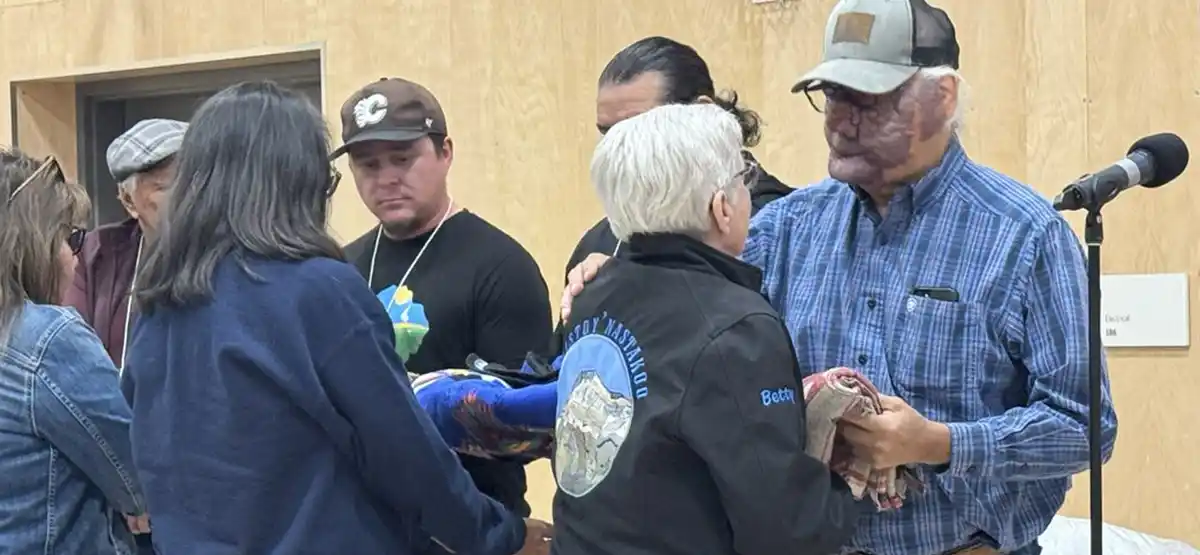
Following the pipe ceremony, Charlie Crow Chief (Mai’stonia) co-founder of KEPA and designer of the KEPA Flag and Lodge (tipi) was honoured and it was announced there will be a scholarship in his name at the University of Lethbridge.
The first speaker of the first day was Dan Fox, who spoke about Iinii (bison) harvesting. He said he was introduced to bison in 2003 after dealing with health issues. He was told by his mother and other elder ladies that many of their people were too quick to jump into western medicine.
“They said ‘us native people were too fast to jump into western medicine’…. they said, ‘we travel too fast to get instant gratification in western medicine.’”
He then researched how to range his own bison and began harvesting them in 2006. During his first harvest, one of the Iinii ran off as he shot another one, and he was instructed by his elders to pray over the Iinii before it was shot. So the next morning he went back and did a ceremony before killing the first bison and the other one stood there, as if it was mourning his friend, instead of running off.
Fox has held many harvests since, often in early fall, as a way to teach the young ones and others who want to know about Nisitapi (Blackfoot) ways of knowing and says he’s honoured to share the teachings with others.
Students from the Tatsikiisaapo’p Middle School hosted a panel talking about what they learn in school, which includes traditional teachings alongside the Alberta curriculum.
They spoke about the interconnectedness between the land and people and how it’s important to show respect towards the land.
They closed off with a performance of Tsahkoomii (Earth Song) along with Olivia Tailfeathers, which can be viewed on the Herald’s Instagram account (@leth_herald).
There were also Panels from both Kainai High School and Red Crow College echoing their connectedness to the land and the importance of Blackfoot teachings within their education.
Before the closing remarks, Shannon Frank, executive director of the Oldman Watershed Council, spoke about the importance of the watershed, and the Oldman River, to the environment.
Frank said last year was one of the worst droughts they have seen in many years and this year is continuing to be a dry year.
“Right now, we are in a Stage 3 drought; we’re actually the only watershed that is in a Stage 3 drought, there’s only five stages, (Stage) 5 is full on emergency, so (Stage) 3 is pretty scary.”
She added the reservoir, which distributes water to many farmers and municipalities throughout southern Alberta, is only 69 per cent full and it likely won’t fill up barring some “serious rainfall.”
To help protect the watershed, which acts like a barrier in times of harsh conditions such as excessive moisture and drought, they have planted several trees along the river. The Oldman Watershed Council has also built bridges along the rivers to prevent of road vehicles from ruining the riverbanks.
Thursday was a “choose your own adventure” with elders being present at Hoyt Tipi Rings, Writing on Stone and cultural demonstrations at Red Crow Park.
The demonstrations included archery and atlatle throwing, which is similar to archery but done with a wooden plank and arrow.
A Guatemalan group shared their knowledge of the Mayan Calendar, which is a 260 day calendar that has different energies each day and is viewed in a counter clockwise circle rather than linear.


Southwest Alberta News, Features and Events
-
 Shootin’ the Breeze Newspaper — Oct. 14, 2026
-
 K’s Thomson closes CFR with top ride of his week
-
 Ridge Flundra finishes second in Canada at first CFR
-
 Ridge Flundra places second again as CFR heads into final day
-
 RCMP step up highway enforcement for Thanksgiving weekend
-
 Help after sexual violence can start with an anonymous call
-
 Opinion: The truth still counts
-
 Opinion: Don’t let Al Gorithm choose your news
-
 How to protect farm fuel and equipment from theft this harvest
-
 Tough night for Flundra and Thomson in CFR round two
-
 Livingstone Ladies sew care bags for women’s shelter
-
 Flundra and Thomson cash in on CFR opening night


Southwest Alberta Municipal News


Government of Alberta News

Alberta RCMP

Obituaries
Opinions

KEPA Summit focuses on environment and culture
The 11th annual Kainai Ecosystem Protection Association (KEPA) Summit was held last week and consisted of three days of learning from Indigenous Knowledge Keepers and Elders, along with others who care for the land.
The theme for this year is Ksaahkomma ki Sokinaapi-Environment and Health and hosted several panelists, including schools located on the Kainai Reserve and the Blackfeet Community College.
The summit began on Wednesday at the Aahsotapi Elementary School in Lavern, which recently opened for the 2024/2025 school year.
The summit was opened with a pipe ceremony led by Elders Peter Weasel Moccasin and Mike Bruised Head.
Following the pipe ceremony, Charlie Crow Chief (Mai’stonia) co-founder of KEPA and designer of the KEPA Flag and Lodge (tipi) was honoured and it was announced there will be a scholarship in his name at the University of Lethbridge.
The first speaker of the first day was Dan Fox, who spoke about Iinii (bison) harvesting. He said he was introduced to bison in 2003 after dealing with health issues. He was told by his mother and other elder ladies that many of their people were too quick to jump into western medicine.
“They said ‘us native people were too fast to jump into western medicine’…. they said, ‘we travel too fast to get instant gratification in western medicine.’”
He then researched how to range his own bison and began harvesting them in 2006. During his first harvest, one of the Iinii ran off as he shot another one, and he was instructed by his elders to pray over the Iinii before it was shot. So the next morning he went back and did a ceremony before killing the first bison and the other one stood there, as if it was mourning his friend, instead of running off.
Fox has held many harvests since, often in early fall, as a way to teach the young ones and others who want to know about Nisitapi (Blackfoot) ways of knowing and says he’s honoured to share the teachings with others.
Students from the Tatsikiisaapo’p Middle School hosted a panel talking about what they learn in school, which includes traditional teachings alongside the Alberta curriculum.
They spoke about the interconnectedness between the land and people and how it’s important to show respect towards the land.
They closed off with a performance of Tsahkoomii (Earth Song) along with Olivia Tailfeathers, which can be viewed on the Herald’s Instagram account (@leth_herald).
There were also Panels from both Kainai High School and Red Crow College echoing their connectedness to the land and the importance of Blackfoot teachings within their education.
Before the closing remarks, Shannon Frank, executive director of the Oldman Watershed Council, spoke about the importance of the watershed, and the Oldman River, to the environment.
Frank said last year was one of the worst droughts they have seen in many years and this year is continuing to be a dry year.
“Right now, we are in a Stage 3 drought; we’re actually the only watershed that is in a Stage 3 drought, there’s only five stages, (Stage) 5 is full on emergency, so (Stage) 3 is pretty scary.”
She added the reservoir, which distributes water to many farmers and municipalities throughout southern Alberta, is only 69 per cent full and it likely won’t fill up barring some “serious rainfall.”
To help protect the watershed, which acts like a barrier in times of harsh conditions such as excessive moisture and drought, they have planted several trees along the river. The Oldman Watershed Council has also built bridges along the rivers to prevent of road vehicles from ruining the riverbanks.
Thursday was a “choose your own adventure” with elders being present at Hoyt Tipi Rings, Writing on Stone and cultural demonstrations at Red Crow Park.
The demonstrations included archery and atlatle throwing, which is similar to archery but done with a wooden plank and arrow.
A Guatemalan group shared their knowledge of the Mayan Calendar, which is a 260 day calendar that has different energies each day and is viewed in a counter clockwise circle rather than linear.
You must be logged in to post a comment.
Southwest Alberta News, Features and Events
- Shootin’ the Breeze Newspaper — Oct. 14, 2026
- K’s Thomson closes CFR with top ride of his week
- Ridge Flundra finishes second in Canada at first CFR
- Ridge Flundra places second again as CFR heads into final day
- RCMP step up highway enforcement for Thanksgiving weekend
- Help after sexual violence can start with an anonymous call
- Opinion: The truth still counts
- Opinion: Don’t let Al Gorithm choose your news
- How to protect farm fuel and equipment from theft this harvest
- Tough night for Flundra and Thomson in CFR round two
- Livingstone Ladies sew care bags for women’s shelter
- Flundra and Thomson cash in on CFR opening night
Alberta and Beyond News, Features and Events
-
 Community celebrates completion of Allison Falls Trail
-
 Adaptable Outdoors wraps season with 300 experiences delivered
-
 Pincher Creek area under fire restriction
-
 Park Guardian Program supports clean green spaces
-
 Bear advisory issued for Alberta’s backcountry and outdoor areas
-
 Volunteers drive Star Creek Trail upgrades for improved hiking experience in Crowsnest Pass
-
 Heed the heat — tips to keep dogs cool and hydrated
-
 Crowsnest to see hiking trail improvements this summer
-
 Safe adventuring
-
 Summer paddling opportunities
-
 Take river safety seriously
-
 Alberta Conservation reminds us to be bear smart


Southwest Alberta Municipal News
Government of Alberta News
Alberta RCMP
Obituaries
You must be logged in to post a comment.