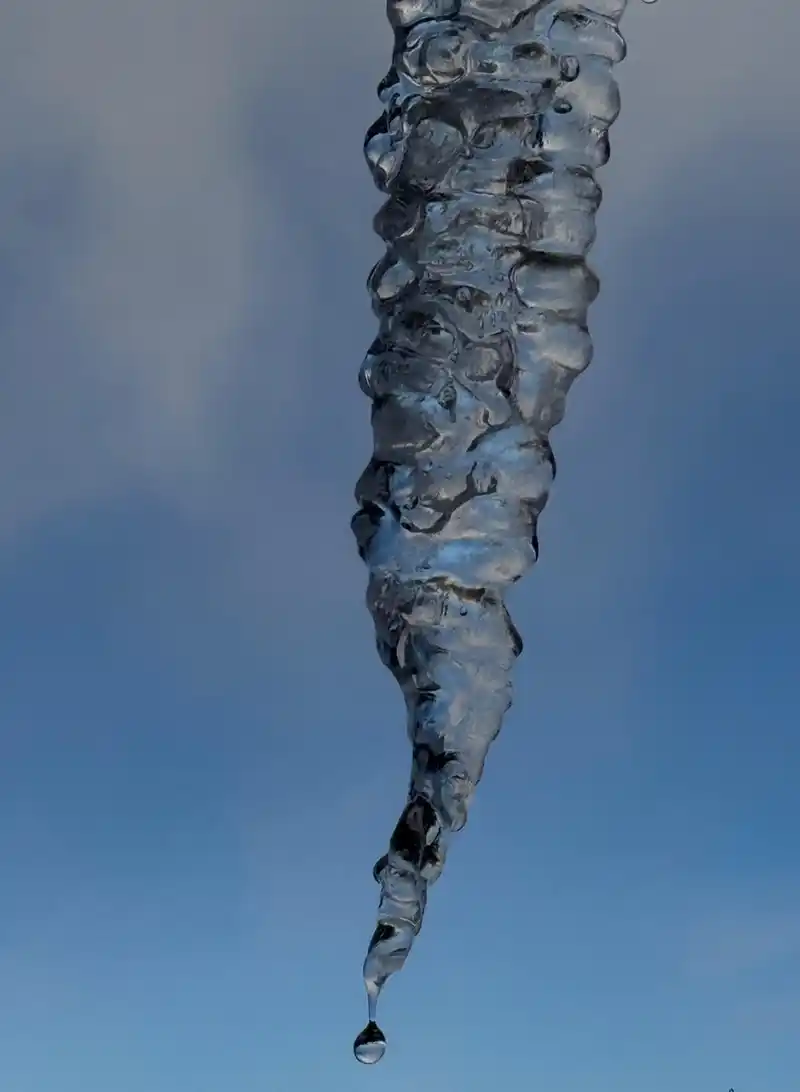
An icicle attempts to feed and nurture the Oldman’s drought-stricken forests, and Alberta’s insatiable thirst for increasingly unavailable water. | Photo by David McIntyre
Opinion: The Oldman cries for help
David McIntyre – Crowsnest Pass
The drought-stricken Oldman is dying.
Here in the fractured heart and soul of the Oldman’s headwaters, taxpayers have spent billions to transform a wealth of heaven-on-earth, Crown of the Continent world-renowned intrigue into a land of mud, stumps, rutted roads and clearcuts.
I shed tears into this soil-compacted sea of loss.
The government, incongruously, stands in defence of this false picture of progress. It does this by demanding that we continue to pay for a fabricated—highly subsidized!—forest products economy and, with it, the ongoing destruction of a priceless and irreplaceable headwaters watershed worth billions.
My home on the eastern gateway to Crowsnest Pass places me in view of this madness. Here, the Crowsnest River valley defines the Rocky Mountain’s thin, narrow waistline, home of Alberta’s rarest, most tree species-diverse forest.
Trees grow here that are found nowhere else in Alberta. There are huge, thickly-barked Douglas-firs, elegant western white pines, two species of native larch, western redcedars, Rocky Mountain junipers, and ancient, gnarled, hauntingly beautiful limber pines and whitebark pines, some likely more than 1,000 years in age.
Within this gorgeous, species-diverse headwaters forest, a harvesting company’s profit is founded on society’s costly uphill attempts to do the impossible: keep a thirsty, water-deprived, mid-elevation matchstick forest of lodgepole pines and white spruces alive for a long century or more, until these little trees can be transformed into 2X4s.
The biggest problems within this tainted picture: insects and fire. A virtual army of hungry forest pathogens feasts on this vast buffet table of matchstick timber. They do this as wildfires start, then race through a banquet of kindling.
It’s the government’s taxpayer-funded, profoundly expensive attempts to transform a dry forest of dog-hair timber into a viable forest industry that’s created a perfect storm.
Within this warped and twisted picture—it’s defined by perpetual watershed loss and headwaters forest manipulation and destruction—the government now asks Albertans to come to the table to discuss a burning need.
It’s not the urgent need to protect the Oldman’s vital—essential to life—multi-billion dollar watershed from decades of costly forest mismanagement. The need, we’re told, is to pay logging companies even more. We’re being asked to endorse the killing of Alberta’s rarest forest at its westernmost edge. We’re told we must destroy this forest at the Oldman’s hydrological apex in an attempt to save communities from the wildfire danger that’s been created.
How might the government best convince Albertans to accept this sudden—and burning— need? There’s no better way than through our innate fear of wildfire.
The government knows that, following long decades of phenomenally costly wildfire prevention efforts, it has created the kindling and fuel to feed a devastating, wind-whipped inferno. Wide-eyed and frightened, government forest managers now offer us false salvation from this red dragon, a dragon they created.
They prescribe a “simple”—clearcut!—overnight fix. The fact that this distracting placebo offers little in terms of meaningful merit is irrelevant. It takes our eyes off the real problem, one the government has no intention of addressing: the further hydrological destruction of the Oldman’s priceless headwaters.
Society’s fear of wildfire makes it vulnerable to anxiety-induced acceptance of quick-fix, clearcut-thinking.
When your brain’s on fire, logic goes up in smoke.
The government’s Community Hazardous Fuels Reduction Program uses society’s fear of wildfire as its primary motivator for public acceptance. It does this as it offers Albertans a false and costly pathway to salvation: an action plan calling for the expanded clearcutting of Alberta’s already severely compromised and priceless headwaters forest.
I offer that this forest’s true worth lies, not in its negligible value as measured in merchantable timber, but in its profound and essential-to-life hydrological value. It’s a vital and living sponge that captures—and then slowly releases—water.
The clearcutting of Alberta’s headwaters forest kills this organic and transpiring sponge and its worth: the capture and slow release of essential-to-life water for 200,000 thirsty people.
Clearcutting amplifies flooding and the potential for landslides. It also, multiplied by its very nature of ever-expanding cumulative impacts, degrades—for decades!—the headwater’s hydrological health and its value as a watershed.
The full magnitude of the unquantified and devastating hydrological and visual impact generated by the vast existing network of headwaters-consuming clearcuts is profound and deeply distressing. Even worse is the fact that it’s compounded by the radiating scars left on the land by virtual squadrons of unregulated off-road vehicles that further muddy a picture of mayhem and loss. Add, too, for the ultimate in viewing a true picture of hydrological devastation, the nightmarish thought that a mountain within this same narrow drought-stricken headwaters landscape has the potential to be sacrificed for a dusty, dirty, water-greedy, watershed-degrading coal mine.
The government, viewing this same picture, sees these outcomes as industry-proposed visions for a better and more prosperous tomorrow.
It’s drop-dead certain that the hydrological health and worth of this headwaters forest for watershed protection is of profoundly greater value than the land’s meagre crop of century-old matchstick timber.
I believe, too, that it’s the GoA’s failed assessment of this headwaters forest’s colossal hydrological worth—in dollars and common sense—to its downstream users that causes it to author and endorse the ongoing clearcutting destruction of Alberta’s priceless headwaters forest, and this forest’s profound, money-in-the-bank hydrological value.
I don’t deny the threat of wildfire, nor the need for society to address the problem.
What I see is that most of the recent wildfires on this headwaters landscape were started as a result of overhead transmission lines. Another problem: the ongoing approvals of new roads and homes within the headwaters fire-prone forest.
It’s this unique-to-Alberta extreme westernmost headwaters forest that the government, today, plans to clearcut—and destroy along with the parallel destruction of this forest’s profound hydrological value—all in the name of “hazardous fuels reduction.”
There is a pathway enabling us to escape from a government-created tinder-dry forest littered with deadfall and despair.
The key to this pathway to success lies in our ability to gain the knowledge and insight provided by issue-defining science. What’s needed is an honest injection of peer-reviewed, multidisciplinary science, and with it, the best available watershed-saving and wildfire-reducing prescription.
What we don’t want, nor can we accept, is a false, quick-fix solution authored by the people who forced Albertans to pay to produce the current problem.
We can’t afford to let the Oldman die.
David, now retired, has a MSc from the University of Washington (College of the Environment) and, for decades, led multi-day study tours through the U.S. West and the Canadian Rockies for the Smithsonian Institution.
Shootin’ the Breeze welcomes your voice.
The Breeze Mailbox is a space for sharing thoughts, stories, and conversations about what matters locally — from letters and opinion pieces to news releases and reader notes.
The views expressed here are personal and don’t necessarily reflect those of our team or ownership, but we believe in making space for respectful dialogue and community perspective.
Submission guidelines:
- Keep it under 800 words
- Include your full name and contact info
- Be respectful and constructive
We reserve the right to edit for clarity, length and tone
Have something to share? We’d love to hear from you. Send your submission to publisher@shootinthebreeze.ca.


