Story Type: Feature

A woman wearing a white Aurora shirt stands beside an Aurora banner and colourful balloons.

Help after sexual violence can start with an anonymous call

Rural residents of southwestern Alberta who have been affected by sexual violence don’t need to drive to Lethbridge to get help, and they don’t need to give their name to start.

The Aurora Sexual Assault Centre, known as the Aurora Centre and formerly the Chinook Sexual Assault Centre, is a non-profit organization that provides trauma-informed services and advocacy for anyone impacted by sexual violence, regardless of age or gender.

While based in Lethbridge, its services extend through much of southwestern Alberta, including Pincher Creek, Crowsnest Pass and communities as far east as the Taber area and as far north as Nanton.

“We are a single-entry point for those that have experienced trauma due to child abuse or sexual assault,” says Kristine Cassie, Aurora Centre CEO. “We serve people of all ages throughout our region … providing them with steps forward on how they are dealing with the trauma that they’ve experienced.”

The centre wants rural residents to know what it offers and Cassie says using its services doesn’t necessarily mean a trip to the city. Appointments are offered over the phone and through Zoom, and staff can also travel within the region when there is a need.

“We’ve done both, so it really depends,” Cassie says. “We also at times will provide when people have limited resources. We can help out sometimes with gas to get into town if they prefer to come in.”

While remote services are an option for rural residents, she says some prefer the anonymity of an in-person appointment in Lethbridge. Regardless of where someone lives, Cassie says, the centre works with each person to find the form of support that best meets their needs.

That can begin with a phone call, and people can call anonymously if they are not ready to give their name, or just to ask what their options are.

Job ad for “Shootin’ the Breeze” seeks part-time and full-time staff for photography, writing, and reporting; contact publisher@shootinthebreeze.ca. Background shows printed news text and a hand holding a voice recorder.

“We don’t expect people to tell us all of the details of what’s happened in the sexual assault or the sexual abuse,” Cassie says. “We don’t want to be secondary witnesses to the crime. We really just want to hear how they’re doing emotionally and what their needs are that way.”

Staff help people decide what fits best from services including crisis support, trauma therapy, peer support groups or specialized justice navigation (help understanding and moving through the police and court process).

Some people need help getting stabilized before they are ready for longer-term therapy, Cassie says, particularly when housing and food security are problems. The centre advocates for them with other agencies when such needs are present.

Longer-term services support people through individual healing processes, rather than following a single prescribed path.

“It’s really important for people to feel connected, to feel that type of support, to work on the issues that led them to seek the services in the first place,” Cassie says.

Peer support groups are part of that, connecting people with others who have similar experiences.

The centre offers several groups for adults, including groups focused on relationships, boundaries and recovery, as well as a weekly drop-in group for adults impacted by sexual violence.

It also offers a peer support program for youths aged 13 to 17 focused on dating abuse and healthy relationships.

Ace of spades card on ad for Chase the Ace at the Pincher Creek Legion

The centre works with people who have experienced recent or historical sexual assault or abuse, including some who carried the experience for years before seeking support. Cassie says clients have included people in their 80s, whose experiences happened recently or much earlier in their lives.

“It’s never too late to come forward, and it always matters,” she says.

The centre’s work also reaches people who haven’t experienced sexual violence first-hand. Through education and professional development, staff work with schools, workplaces and community groups on topics such as consent, healthy relationships, bystander engagement, sexual violence and trauma, sextortion and exploitation, and workplace sexual harassment.

Who Do You Tell? is a school program offered from kindergarten through Grade 6, which teaches about body boundaries, inappropriate sexual behaviour and identifying adults they can tell if they feel uncomfortable or have experienced abuse.

Cassie says prevention work is an important role of the centre, particularly helping people recognize how to respond when someone discloses an experience of sexual violence.

“The first thing is that we believe,” she says. “When people are telling us something that has happened in their life, it’s really important that we believe them when they say it.”

She says people who are supporting someone who has experienced sexual violence do not need to have all the answers themselves.

“We don’t have to be perfect to be helpful,” Cassie says. “Tap out. Bring us in. Bring in people that know this, to give that type of support.”

The organization has grown from six staff to 25 since 2019, gradually expanding to include the Aurora Child and Youth Advocacy Centre.

The Aurora Centre provides a co-ordinated response for children who have experienced sexual abuse, severe physical abuse or severe neglect, working alongside police, Crown, child protection, medical and mental health agencies.

Referrals to that program come through child protection agencies, partnering child and youth advocacy centres or policing services. People unsure whether the program fits a child can still contact the Aurora Centre for guidance.

Last year, Cassie says over 200 children and youth were referred to the advocacy centre, while the sexual assault centre recorded 744 crisis calls.

Cassie says the Aurora Centre’s growth has also meant looking at populations and issues that require more attention, including older adults, people with disabilities, faith communities and technology-facilitated sexual violence.

The centre is also working toward a restorative justice program for adults impacted by sexual violence. Cassie says the model and its evaluative framework have been developed, but the organization is seeking funding to launch the program.

She says the most important thing is that people understand they do not need to have everything figured out before asking for help.

“They’re welcome to call, they’re welcome to engage with us,” she says. “Don’t be shy. Ask us some questions, come visit with us.”

A bearded man in a cap smiles while playing guitar. Text promotes a Lloyd Spiegel concert at Empress Theatre, October 14, 2026, with ticket details and contact info.

Cassie says anyone who sees Aurora staff at a community event and isn’t sure about the centre is welcome to drop by the table.

“It is anonymous, it is confidential,” she says. “We’re open to the questions that you have, and we’ll help you find what you need.”

The Aurora Centre is at Suite 502, 740 Fourth Ave. S. in Lethbridge, and is open Monday to Friday from 8 a.m. to 5 p.m.

Those looking for more information or to access services can call 403-694-1094 or toll-free at 1-844-576-2512. Information can also be found online at aurora-ab.ca.

Alberta’s One Line for Sexual Violence is open daily from 9 a.m. to 9 p.m. at 1-866-403-8000.

Related stories

Increased demand for victim services, volunteers needed

Consent, Peer Support, Restorative Justice, Sexual Violence Counselling

Two women stand indoors holding colourful fabric toiletry bags beside a box.

Livingstone Ladies sew care bags for women’s shelter

Lori Van Ee was all smiles when Deb Hollingshead of the Livingstone Ladies Social Club presented her with a surprise gift of 14 homemade toiletry bags filled with personal-care essentials on Sept. 22.

Lori, executive director of the Pincher Creek Women’s Emergency Shelter Association, says the shelter was running low on soap, shampoo, toothbrushes and other personal-care items.

Now, the next 14 clients who arrive at the shelter needing essentials will each receive a colourful, fully stocked bag.

One member of the Livingstone Ladies suggested making toiletry bags from leftover quilting fabric this spring.

“Five or six members then brought sewing machines together and spent two afternoons cutting fabric and sewing pieces together,” Deb says.

Club members bought the products that fill them.

“We put a little tag inside each bag indicating that the bags were sewn by Livingstone Ladies,” Deb says. “We wanted the recipients to know that someone is out there who is thinking of them, and wishes to support them. These are not just store-bought factory made bags.”

The club began in 1913 when women from Pincher Creek to Coleman, and south of Lundbreck to North Fork, started getting together to support each other and carry out projects for the Red Cross. There are 21 members, one of whom has been on the membership roster for 68 years.

Event flyer for International Credit Union Day at Vision Credit Union on October 15, inviting community members to bring food bank donations in exchange for a wall calendar.

Club members serve luncheons for funerals and memorials in the Cowley area and host annual summer barbecues and Christmas dinners for members. They also maintain the Livingstone Cemetery, located 15 kilometres north of Cowley.

In June, the women’s shelter marked 20 years in its current 16-bed, six-room facility. It serves women and children with a mandate for the shelter to be a place “for all people in southwestern Alberta to be safe in their homes and safe in their communities.”

Lori says the shelter’s biggest needs right now are monetary donations, or gifts of bedding, towels, and pots and pans, along with large-size hygiene products.

To arrange a drop-off, call the outreach intake worker at 403-627-2114, weekdays from 8:30 a.m. to 4:30 p.m., or visit pcshelter.ca/donations.

“We are also looking for groups who could make some nice bags for us to create hygiene bags for the women that come in,” Lori says.

Anyone needing the shelter’s help can call its 24-hour crisis line at 1-888-354-4858.

Community Giving, Sewing, Volunteerism, Women’s Shelters

Travelling Library a hit with Piikani children and elders

“Can I come travelling with you more often?” Piikani Elder Eric Crow Shoe asked Sam Bonwick as the Pincher Creek Travelling Library wrapped up its first visit to Otskoipik’saki Daycare Centre in Brocket on Sept. 17.

Sam, Pincher Creek Municipal Library’s outreach co-ordinator, and Piikani Nation member Annette Bad Eagle once worked together at Canyon School’s daycare in Pincher Creek.

The Travelling Library has long been a dream for both women. They want to use books to support reading skills and cultural awareness among young people of both Indigenous and non-Indigenous heritage in Pincher Creek and Brocket.

Along with Elder Doreen Weasel Bear and Elder Eric, Sam and Annette held two storytime sessions at the daycare.

Dolly Provost, a child-care teacher in the infant room, attended daycare in Brocket herself in the early 1970s. Classes were held in portables then, decades before the current building went up.


Two child-care teachers sit with young children and books in a daycare play area.

Dolly Provost, front, and Maryanna Smith, child-care teachers in the infant room, help children practise holding and opening books.

Hannah Noerenberg © 2026 Shootin’ the Breeze


“It’s good for the children,” says child-care teacher Maryanna Smith. “It’s a new experience having someone new read to them.”

Maryanna says that while the main language spoken in the daycare is English, individual words, phrases and daily routines are introduced to the children in Blackfoot as much as possible.

She was introduced to Blackfoot the same way as a child. When Elder Eric provided the Blackfoot words for moon and stars during the reading, Sam and others tried repeating them.

Ad for Blinds and More Fall Sale: 40% off Alta Blinds from Sept 15 to Nov 30, 2026. Living room with large windows covered by wood blinds. Contact info and locations listed.

Sam uses her own literacy development as an example.

“I used to read very slowly,” she says. “It was a real struggle. But I find the more I read, the quicker I get.”

In addition to supporting young readers, Annette and Sam want to encourage elders to share more of their oral stories with younger generations.

The plan is for Sam to return to Brocket with her box of books and for Annette to become a regular guest at the library in Pincher Creek.

Related stories

Around the world in six weeks at the Pincher Creek library

Blackfoot Language, Children’s Literacy, Library Programs, Storytelling, Travelling Library

Randy Plain Eagle brings his story and his stage home

Randy Plain Eagle always felt he was different. He liked playing with Barbies and with the girls, rather than doing what the other boys did, and the bullying that followed taught him to hide.

“It really affected me,” he says, “I didn’t want to be seen.”

So he started skipping school.

By the time he reached Piikani Nation Secondary School, he longed to be seen and dreamed of acting. The school learned he hoped to perform and brought in Trickster Theatre, which built a production for the whole school about Randy setting out on a vision quest.

It was his first time working with lights, choreography, sound and other performers. When it ended, the audience stood and applauded, and afterward, people came to Randy’s part-time workplace to tell him how great he’d been in the show.

“This is what I’m meant to do,” he remembers thinking. In those moments Randy experienced the validation he didn’t feel growing up.

He is now 33 and an artist building a career with Justin Many Fingers, his partner in life and work. September has barely given Randy room to breathe, but he is revelling in it all.

On Sept. 2 he started his second year of arts and cultural management studies at MacEwan University, taking a full course load, and on Sept. 18 made his runway debut at the Indigenous Fashion Show at Casa in Lethbridge.

Poster for Pincher Creek Chamber’s 31st Annual Awards of Excellence on October 23, 2026. Ticket prices and event details are listed, with a link for tickets at PincherChamber.ca/tickets.

The next day, he and Justin spoke at Lethbridge Public Library’s Word on the Street festival about the Niitoyis Method, a Blackfoot approach to creating theatre that Justin developed, modelled on the structure of the teepee, and how it shaped Randy’s one-person show Sugar.

Last Friday the pair were busy helping with the Drum Grid choreography that moved drummers and powwow dancers around Fort Macleod’s main street.

All of this followed Aug. 31, when Sugar, Randy’s show about addiction, survival and recovery, was presented at Piikani Nation for International Overdose Awareness Day.

Randy has big plans and getting this far took him across the country and back.

Leaving home

Randy grew up one of eight children raised by a single mother, with a few early years in Pincher Creek before the family moved back to Brocket. Like many Indigenous families, his carried intergenerational trauma, including addiction and children being removed from their homes. Randy saw that cycle repeat in his own childhood.

“When I was about 16, I finally started to walk into my own confidence, but I was still trying to figure out who I was as a person and as a young, Blackfoot man,” Randy says. “I was by myself.”

Around that time, the late Troy Emery Twigg brought a performance workshop to Brocket. Troy was a Kainai dancer, choreographer and director who taught across the country, including at the Centre for Indigenous Theatre.

Randy shared his desire to perform with Troy, who told him about “this really cool opportunity out in Toronto.” Finishing high school and the Trickster performance came first, but the teenager now had a goal and was set on making a name for himself.

Get Stuff’d meat and seafood shop sign, located at 214 13th St. in Fort Macleod, open Thursday through Saturday from 12 noon to 6 p.m., phone 368-996-1968, follow us on Facebook at Get Stuff’d.

He spent weekends drinking and hanging out with friends.

“I’d drink all weekend, go home, wake up, go back to school,” Randy says. “I was managing it and just being a teenager, so at the time it wasn’t a problem.”

He was serious enough about acting to round up letters of support, look for funding and get a plan together. Randy’s mom and sister dropped him at the Greyhound depot in Fort Macleod, and 63 hours later he landed in Toronto.

Randy’s journey at CIT taught him to act, find his voice and create performances through an Indigenous lens. Ironically, it was also where he first met Justin, though the two came from neighbouring reserves.

There was a dark side to Randy’s time in Toronto and he discovered city life was fast and chaotic. It became a balancing act between school and the party, with him struggling to stay afloat.

“At that time I was still very much in the closet, not really stepping into who I am and what my identity is,” Randy says.

Along with the other challenges, he was young and naive, and navigating being a Two Spirit person.

After graduating, Randy hung onto the party lifestyle.

An older couple smiles while leaning on a wooden railing outdoors, above text describing their $879 profit share from Vision Credit Union and a website link.

“That would be OK on Friday but by Sunday, I was just so damn depressed and questioning everything I’m doing,” he says. “Why am I here? I’m so lonely. I feel so disconnected, I feel so lost.”

He was 23, “and up until then it was trauma after trauma after trauma.”

It was time to make the bus trip home to Alberta.

The long way back

Randy went to Calgary, where he hoped to put his experience and skills to work. He researched companies and did some workshops, but found himself still drinking and partying. Nothing had changed except being introduced to meth.

“I was in a new environment doing the exact same shit,” he says.

After a performance in Brocket, Randy and his friends celebrated with drinks as he’d learned was the norm in the Toronto arts scene.

“It’s not normal for native people,” Randy says. “That’s not how we celebrate.”

Event poster for a Secondhand Dreamcar concert at the Empress Theatre on November 20, 2026, at 7:30 PM, featuring a photo of the band members.

But it’s what they did, and it led to a crash in Calgary when the driver, who had been drinking, hit a pole. Randy almost lost his life. His leg was badly cut through ligaments and tendons, and doctors said he might not walk again. It was devastating news for the young man who loved to dance and move.

“That’s what made me feel free and so that fear of not being able to do that again was very frightening, but then I was introduced to morphine for pain management,” Randy says.

He found it numbed more than his leg. For a while, the emotional pain he’d been carrying went quiet and he felt almost “normal.”

He missed an audition, but when he heard the director was leading a workshop in Pincher Creek, he went to find her. She asked whether he’d be healed by summer and when he said yes, she hired him.

He was one of only four Indigenous performers cast in the 2017 production of The Dream Catchers, a Canada 150 show that toured coast to coast. He says it gifted him the hoop dance but it also brought him face to face with Canada’s history with Indigenous people, and the road was lonely.

“You just felt all of the weight of the oppression and I think that was when I first learned of the bad, bad history that Canada has with my people,” he says. “I just became really bitter on that project. Every time we finished the show I drank.”

When the tour ended, Randy had a layover in Calgary and chose to stay rather than continue to Lethbridge. That choice, he says, is where the cycle of addiction began to snowball.

He worked for independent theatre companies for a time but, as his addiction deepened, Randy lost his housing and cycled through detox and relapse.

After about five years in the city, Randy went missing. His family and community members went to Calgary to search for him, plastering posters everywhere.

“When I realized my face was on almost every pole, I realized that I was loved and that my family was there looking for me and trying to take me home. That was the moment when I started to try,” Randy says.

“Recovery is not a straight-and-narrow path. For me it’s always getting back up and keeping trying.”

Randy needed to get sober for himself and for his family. In 2022, he went through detox and about 60 days in the pre-treatment program at Inii House on Piikani Nation, then treatment in Medicine Hat. He has been sober since 2023.

It was time to go home.

‘You have a story’

Randy and Justin also reconnected in 2022. After a family dinner, where Randy’s mother told Justin what Randy was like when he came home, Justin said, “Randy, you have a story.”

He wasn’t ready to tell it yet.

“There was guilt and shame in my body,” Randy says.

Justin reminded him the story was a gift that could help people. Randy asked himself how he could use what he’d lived through and learned, and started to write.

A professional development grant took him to Decidedly Jazz Danceworks in Calgary, a company he had researched years earlier and written off as out of reach. He was invited as an artist in residence and Sugar was developed there.

The Canada Council for the Arts funded its research and creation in March, and it played the Ignite! Festival in Calgary this spring.

Then Randy brought it home.

He spent the summer in a student position with Aakom-Kiyii Health Services and Akoka’tssini Mental Wellness, and together they built the Aug. 31 gathering to honour loved ones lost to addiction, and offer support and wellness information to everyone who came.

The show opens gently, with a grandmother telling her grandchildren a bedtime story about the Niitsitapi, the real people. Then Napi, the Blackfoot trickster, steps in and hands candy out to the audience, promising a sweet story with a warning attached.

“There’s always a cure for too much sugar,” he tells them, “and that, my friends, is more sugar!”

Randy plays every role. There is Sister Bear, who shares the boy’s childhood and later leads him into the city’s nightlife; Kitty, a street-smart booster who turns shoplifting into an art form; Danny, whose sweetness is its own kind of danger; and the Candyman, who runs downtown. On the street, the boy goes by Shugs. Sugar itself gets a voice too, promising confidence and belonging to anyone lonely enough to listen.

There is the mother, searching for her missing son, walking the back alleys and visiting shelters with posters and desperate hope until someone on the street says they know him. When the young man is close to dying, the spirit of a grandmother, wearing his mother’s face, turns him back, saying “Family is medicine.”

The show doesn’t gloss over drug use, overdose or the sickness of withdrawal, but it also has humorous moments and ends with a joyful dance.

Sugar is not an exact retelling of Randy’s story but draws on his life and people he met along the way.

Justin says a powerful moment came in the talk-back afterward, when a woman said her daughter has struggled with addiction for years and that she finally understood her after seeing the show.

That’s the point. “To have people feel something and work through it, and remind them that they’re not alone and that hope is possible, no matter how hard you struggle,” Randy says.


Justin Many Fingers joins Randy Plain Eagle for the talk-back after the performance of Sugar.

Submitted photo


Coming home

Randy made the dean’s list in his first year at MacEwan, where he studies online to learn the business side of running an arts company. His versatility as a performer and speaker is opening opportunities for him to give back to the community through Plain Eagle Productions.

Justin completed a master of fine arts degree at the University of Calgary this year, with research on Blackfoot knowledge and performance. In Blackfoot, he says, there is no single word for “artist” because art has always lived inside ceremony, song, story and design.

Coming home was deliberate.

“All of our stories come from here,” Justin says, and Drum Grid showed what that can look like.

Maria Crowshoe started the A’sitapiiksi Powwow Club in June because her grandson wanted to learn to dance. She saw Randy’s posters and asked him to teach the young dancers confidence and performance skills. He ended up choreographing and brought Justin in.

It was challenging to carry the spirit of powwow, which is celebration rather than performance, into a staged show, but they figured it out. Justin also says the setting mattered. Fort Macleod is where rations were handed out after the buffalo were gone and seeing young dancers celebrate on its main street felt like hope.

Randy and Justin are developing two versions of Sugar. One will be a full theatre production and the other a touring version suitable for schools, treatment centres and conferences. This includes creating a plan for audience members who need support and protecting the actor himself.

Other work is underway, including a Napi creation story, speaking engagements, a Treaty 7 anniversary project and “Two Directions,” a movement duet exploring Blackfoot understandings of Two Spirit identity. They also want to build an arts network that brings other nations’ shows to southern Alberta and takes theirs on the road.

The boy who once skipped school, so no one would see him, now stands on stage asking audiences to see one another and trust that anyone can find their way home.

If this story raises concerns for you or someone you love, Alberta’s 24-hour Addiction Helpline is 1-866-332-2322 and the Hope for Wellness Helpline for Indigenous people is 1-855-242-3310. Aakom-Kiyii Health Services can be reached at 403-965-3919.

Related stories

Drum Grid brings drums and dance to Fort Macleod’s Main Street

Addiction, Blackfoot Culture, Indigenous Arts, Indigenous Theatre, International Overdose Awareness Day, Napi, Performing Arts, Powwow Dance, Recovery, Theatre, Two-Spirit

Thirty years on, Irene Hollander still walks for Terry Fox

After finishing her 30th Terry Fox walk Sept. 18, Irene Hollander stopped beside a poster near the Canyon School gymnasium in Pincher Creek. It honours her late husband, Wayne, who spent many hours in that gym as a volunteer coach and joined her on many Terry Fox runs over the years.

Wayne coached youth sports from the age of 20, including hockey, basketball and volleyball, often on Saturdays while working full time, and coached almost full time once he retired.

Irene and her friend Susan Knight walked the full route with Canyon School students, staff and parents, heading north to the walking path along the creek and returning to the school through the ag grounds.

In 1996, Irene was working as a hairdresser and could set her own schedule. She recalls volunteers organizing Terry Fox runs for the entire community.

When the leader stepped down, Irene approached Canyon School to see if staff would take on the event so the community could keep supporting the Terry Fox Foundation. She has not missed a year since.

Once, when terrible weather caused the school to postpone its walk, Irene went ahead on the original day, then walked the distance a second time a few days later when the school rescheduled.

Canyon School has five Terry Fox Lives Here banners from the Terry Fox Foundation marking its years of participation, and principal Jess Ames says the next should mark its 30th year.

Donor pledge forms were handed out to Canyon students at the start of the school year, and students raised more than $1,000.


Canyon School students gather out front before their Terry Fox walk. Principal Jess Ames says a record number of parents joined this year.

Hannah Noerenberg © 2026 Shootin’ the Breeze

Irene Hollander stands with a poster honouring her late husband, Wayne, near the Canyon School gymnasium after her 30th Terry Fox walk.

Hannah Noerenberg © 2026 Shootin’ the Breeze


At the age of 18, Terry Fox lost his right leg to bone cancer, enduring 16 months of treatment and learning to walk with an artificial leg. The young man from Port Coquitlam, B.C., set out from St. John’s, N.L, on April 12, 1980, on his Marathon of Hope to raise money for cancer research.

Averaging 42 kilometres a day, Terry’s mission took him nearly 5,400 kilometres across Newfoundland and Labrador, Prince Edward Island, Nova Scotia, New Brunswick, Quebec and Ontario, through all kinds of weather and terrain. Sometimes school groups and others joined him; other times Terry ran alone. By February 1981, his run had raised more than $24 million.

But Terry didn’t make it to Manitoba. After 143 days, his marathon ended Sept. 1 just outside Thunder Bay, Ont. Cancer had spread to his lungs. Cross-country runs were novel at the time, and Terry had won support from Newfoundland to his home province.

“I want to set an example that will never be forgotten,” Terry said.

He died June 28, 1981, at 22.

The first Terry Fox Run was held Sept. 13, 1981. According to the Terry Fox Foundation, runs in his name have raised more than $1 billion for the foundation’s research grants programs, the Marathon of Hope Cancer Centres Network and the Digital Health and Discovery Platform.

Donations to the Terry Fox Foundation can be made online at terryfox.org.

Cancer Research, Community Legacy, Fundraising, Marathon of Hope, Terry Fox, Terry Fox Run, Volunteerism

A woman seated on a tall stool speaks indoors while holding a book.

Daughter shares Rose Potts’s residential school story at Vista Village

Rose Potts was four years old when a crew from the supply boat that brought food to communities along the Mackenzie River took her and one of her brothers away to residential school.

“I have cried for my mother ever since,” Rose said.

Now 103 and a resident of Vista Village in Pincher Creek, Rose was at the centre of a talk her daughter, Margaret Potts, gave to about 14 residents on Thursday, ahead of the National Day for Truth and Reconciliation on Sept. 30.

“It’s not just a story or a day. It’s a life,” Margaret said.

She said that even though her mother carried some of the lifelong impacts of her residential school experience, Rose always believed people should be good to one another and care about others.

Simply walking alongside families affected by this trauma can help advance healing. That was one of the messages in a short film Margaret played. Produced by the Aboriginal Peoples Television Network, the video shared clips of people speaking both before and after the visit and apology by Pope Francis in 2022.

In 1920, the federal government made residential school attendance compulsory for First Nations children aged seven to 15. Duncan Campbell Scott, the top civil servant in the Department of Indian Affairs, said the goal was to “get rid of the Indian problem.” Brothers and sisters were often separated, and children who spoke in their mother tongue were severely punished.

The Truth and Reconciliation Commission, established in 2008, gathered stories from residential school survivors across the country. In 2015 it released 94 Calls to Action, including one asking for a national day to honour survivors, their families and their communities. Parliament made Sept. 30 that day in 2021.

Recreation therapy aide Suzanne Teran and some of the residents present said they feel like one extended family. Learning on a personal level about what is going on in the lives of others is something that regularly happens at Vista Village, they said.

If this article raises difficult memories, the National Indian Residential School Crisis Line is available 24 hours a day at 1-866-925-4419. 

Related stories

Marie Wilson and Stephen Kakfwi discuss healing journey

Dave Friesen first investigated residential school in 1950s

94 Calls to Action, First Nations, National Day of Truth and Reconciliation, Reconciliation, Residential Schools

A woman raises a white cloth beside a memorial display with a red dress.

A Piikani mother puts one foot in front of the other for her daughter

Beside a campfire under a full moon, in a supporter’s yard near Surrey, B.C., Stephanie English opened the small bundle of her daughter’s belongings for the first time.

Police gave her the bundle 10 years ago. It holds items found with Joey-Tiiah English, a 25-year-old mother of three from Piikani Nation who was reported missing in Calgary in June 2016.

Some of her remains were found weeks later in a wooded area of Calgary’s Crescent Heights neighbourhood. According to facts agreed to in court, she died of an overdose, and a man she had been using drugs with dismembered her body afterward and discarded it.

The man, Joshua Weise, pleaded guilty to indignity to a human body and was sentenced to 18 months in jail. Police searched a Calgary landfill but found no more of her remains, and Stephanie has never been able to bury her daughter in full.

Stephanie opened the bundle Sept. 23, partway through a run from her Piikani Nation home to Vancouver, surrounded by people who understood her grief.

Stephanie ran through a highway tunnel, up and down hills in the Okanagan, stopping in communities that have suffered losses like her own.

She made the run ahead of her ninth annual walk to Calgary, which starts Oct. 2. Her mother, Patsy English, Joey-Tiiah’s daughter and her own daughter followed in a vehicle. It was their first visit to Vancouver.

“This was primarily a spiritual journey for myself,” Stephanie says. “I am really humbled by what was going on; I am still processing what I experienced. I got a lot of support from the community of sisters that know and understand.”

She means families who have lost daughters, sisters, aunts, grandmothers and Two-Spirit loved ones to violence or disappearance, and who, she says, have too often seen police and society fail to solve or stop those crimes.

Stephanie is grateful for the reception she got in Invermere and other stops along the way. She recalls stepping onto the long Fraser River bridge feeling especially heavy-hearted.

For many years, she has carried the weight of running to create awareness of not only her daughter’s case but also the cases of many others. This time, she thought about how more and more people are speaking out.

“I pray that more people will wake up and get out of their silence once they start reaching out for help,” Stephanie says.

She believes the silence many feel over such losses is slowly starting to lift and says Indigenous liaison workers in police services are pushing their colleagues to take these cases seriously. Stephanie says she no longer feels institutionalized racism when dealing with police.

People seem willing to listen, she says, even if concrete actions have not been taken in her daughter’s case. As she ran, her spirits lifted, especially when she saw a pair of eagles and their young flying overhead.

At a small gathering in Vancouver-Hastings, people shared songs and prayers. There, Stephanie met people she calls sisters and brothers in the Sisters in Spirit movement, including Dennis Saddleman, the author of From Residential School to Word Warrior.

At the same Surrey campfire where Stephanie opened Joey-Tiiah’s bundle, she, her mother, her daughter and her granddaughter were gifted blankets with thunderbird, butterfly and star designs.

Much still weighs on her.

Stephanie says governments have not honoured the treaties signed with her people, and she points to a foster care system she calls broken, human trafficking she says is getting worse, and ongoing discrimination against First Nations people.

Above all, she continues pushing to recover the rest of Joey-Tiiah’s remains, which she believes are in a Calgary landfill.

“It makes me push harder with love, the more we get denied, the more I push deeper,” she says.

Stephanie invites all who are able to join her on the annual Sisters in Spirit walk to Calgary. Walkers leave from Range Road 274 and Highway 3 at 6 a.m. on Friday, Oct. 2.

The next day, community members will welcome them at the Awo Taan Healing Lodge in Calgary. From there, the walk continues to destinations in the centre of the city.

Stephanie asks those who cannot join what she sees as a form of bridge-building to keep the participants in prayer.

If this story raises concerns for you, the national support line for families and survivors of missing and murdered Indigenous women, girls and 2SLGBTQQIA+ people is available 24 hours a day at 1-844-413-6649. Alberta’s 24-hour Addiction Helpline is 1-866-332-2322.

Related stories

No More Stolen Sisters: Pincher Creek community raises awareness with Sisters in Spirit walk

First Nations, Highway 3, Human Trafficking, Indigenous Healing, MMIWM2S+, Residential Schools, sisters in spirit, Two-Spirit

Two people stand in tall grass holding a red MMIWM Spirited+ banner near a Welcome to British Columbia sign.

‘We walk for those who cannot walk beside us’

Stephanie English of Piikani Nation brought the following statement to Shootin’ the Breeze before setting out Sept. 20 on this year’s Calling My/Our Spirit Back Unity Walk. Inspired by the deaths of two of Stephanie’s daughters, it carries a message of remembrance and healing while honouring families of missing and murdered Indigenous and two-spirit people, residential school survivors and all impacted. This year’s walk, the ninth annual, is a walk, ride, run format from Brocket to Vancouver, and a finale at the Sisters in Spirit gathering in Calgary on Oct. 4. She asked it to be printed exactly as written.

Our walk is more than footsteps. It is my mother’s love for our daughters. It’s prayer and a call for Justice. My greatest dream is to one day bring my daughter Joey-Tiiah’s remains home from the landfills and to lay her to rest with dignity. Joey-Tiiah Gentle Woman deserves this.

Until that day comes, I will continue walking, not only for my daughters but for every MMIWM2S+ person and for every family still searching and morning praying and waiting.

I walk so our families do not lose hope or faith. I walk carrying the love of those who have gone into the spirit world, believing their spirits are beside us. Singing, dancing and praying, and reminding us to do good in this life.

I also walk for our younger generations. I want them to see that we can break cycles within our families and communities with truth, honesty and respect. We can follow our visions and teachings given us, stand together, protect one another, and protect the lands that held our people for thousands of years to this day.

This journey is about Unity. We must stand together as One people and One Nation.

No mother should have to fight to have a landfill searched for their Child. No human being should be treated as garbage or as disposable trash.

Until our loved ones are brought home, we will continue to walk, pray, speak their names and demand that they are not forgotten. As a mother, this is a 365-day reminder why I speak and seek help and support of the four directions across Turtle Island.

Search All Landfills. Bring Gentle Woman (Joey-Tiiah) and our loved ones home.

Protect our daughters, sisters, mothers, grandmothers/fathers, uncles, nephews and two-spirited, and our future Generations.

We walk for those who cannot walk beside us. We speak for those whose voices were taken and not heard.

And we will not stop until they come home.

This is for all walks of life, yet it hits harder for me as a First Nation mama bear.

Love,

Natowawhkii (Walking Holy Woman)

Stephanie English

Calling My/Our Spirit Back Unity Walk, First Nations, Indigenous Healing, Missing and Murdered Indigenous People, MMIWM2S+, Remembrance, Residential Schools, Two-Spirit

Twin Butte mental health fundraiser aims for smiles, not sorrow

Guests at this year’s Twin Butte mental health fundraiser are invited to dig out their best 1950s and ’60s outfits for an evening organizers want to be anything but sombre.

“We want this event to be happy, and for everyone to walk away with a smile on their face, and to know that everything is OK,” says Jeny Akitt, who owns Twin Butte Country General Store and Restaurant with her husband, Phil.

The store and the Twin Butte Community Society host the annual fundraiser Saturday, Sept. 26, at Twin Butte Community Hall. This year’s theme is Cheeseburger in Paradise. Cocktails start at 5 p.m., with dinner at 6.

The evening includes dancing, live and silent auctions, and live music from Peter and the Wolves. Tickets are $50 per person, with all proceeds going to the Canadian Mental Health Association, Alberta South Region in Lethbridge.

The Akitts started the fundraiser in 2022 with Jaime and Scott Mitchell, whose 17-year-old son, Zachary, died by suicide in 2021.

Akitt estimates that the event has raised close to $80,000 for the CMHA since it began, adding that its purpose hasn’t changed as the event has grown.

“We would just love for everyone to join us for this great event and to know that everybody goes through hard times and that we’re here to support you,” she says.

Akitt says the fundraiser is also about making conversations around mental health more common in rural communities.

“I think that starting the conversation and knowing that you’re not alone out there and that everything is OK and to talk about things that are bothering you or just how you’re feeling is not a bad thing,” she says.

The evening is intended to be a celebration, despite the circumstances that inspired it.

Tickets are available from Akitt at 403-627-4035.

Individuals and businesses can donate auction items by calling Akitt or Mitchell Welding, at 403-632-9458, to arrange drop-off or pickup.

Folks who can’t attend can donate to the Canadian Mental Health Association online at cmha.ca.

If you or someone you know is thinking about suicide, call or text 988 any time to reach the Suicide Crisis Helpline. The Alberta Mental Health Help Line is available 24 hours a day at 1-877-303-2642.

Related stories

Mental health fundraiser a great success

Save the Truck fundraiser keeps PTSD walk on track

Fundraising, mental health, Suicide Prevention

At left is a portrait of an older man. At right, a woman cuts a ribbon outdoors while another person holds the ribbon.

Blackburn Jewellers celebrates 90 years, looks ahead to 100

Need a watch battery changed in Pincher Creek? Blackburn Jewellers is the place to go. Need a chain re-hooked, a watch band shortened or a gift wrapped with ribbon? The store has been doing those jobs for generations.

On Sept. 3, Blackburn Jewellers will mark 90 years on Main Street — a milestone that, for owner Doris Blackburn, carries a second, more personal anniversary. It has also been 30 years since she left her life in Edmonton and returned home to help her aging father run the family business.

When Doris returned in 1996, she thought she was simply coming home to give her father a hand. Instead, she became the latest person responsible for carrying a family business into its next generation. Three decades later, she is looking ahead to a centennial anniversary.

A phone call that changed everything

Doris grew up in the business, working at the store on Saturdays and during Christmas. She learned from her father, Laurie Blackburn, who was the town watchmaker for more than 60 years.

She left Pincher Creek after graduating in 1979 and went to university, later settling in Edmonton. In 1987, she briefly returned to work at the store while her sister was on maternity leave.

By the mid 1990s, however, her father was getting older and running the business largely on his own. Doris’s sister called in 1995 and said their father needed help.

“I knew that I would come back to help my dad because, in my life, my parents never said no to me,” she says.

She expected the move to be temporary. Instead, she spent the next 3½ years working alongside her father.

Laurie died of a brain hemorrhage in 2000. By then, Doris was deeply involved in the business and continuing it felt like the natural next step.

“I just never really thought ahead, because we can’t plan our future,” she says. “I’m so grateful that I moved back.”

Lessons from her father

Doris says her father taught her the value of doing a job properly, even the smallest ones. She remembers him sending her out to sweep the sidewalk, then checking her work himself.

The lesson was about more than sweeping. He believed that if a job was worth doing, it was worth doing well — a principle Doris says has stayed with her in business and in life.

“If you have honest and direct communication, then you can have a clean conscience,” she says. “I think that’s very important in business.”

Working in a male-dominated trade

Watch repair and jewelry making have long been considered male-dominated trades. Doris says she faced some skepticism when she took over the business, but it did not last long.

“Most people are very accepting of a female, especially if you’re confident that you can do the work,” she says.

After her father’s death, an older gentleman phoned to ask whether she knew how to use the tools. Doris grew up around tools. Her father taught her how to use them and she was always the one doing repairs around her own house.

“My dad bought me all my tools,” she says. “My dream job would be to work in a hardware store and sell tools.”

“When you have confidence in yourself, people will believe you,” Doris says. “I never doubted my own abilities. I think that’s the biggest key in any success.”

Changing with the times

Doris says the jewelry and watch business looks very different than it did 30 years ago.

Camera phones ended the demand for picture frames, once a steady seller in the store. Smartphones have also cut into watch sales, though some customers still buy watches as fashion pieces.

“There’s not a lot of young people wearing watches,” she says.

Technology has changed how the store operates, too, with Doris introducing the store’s first computer in 1999.

Her store windows remain important. A recent display called “The Mountains Are Calling” drew tourists into the store, including one visitor who sold Doris a new line of local honey.

“All my store windows are huge attractors,” she says.

A full-service store

Blackburn Jewellers sells jewelry, watches and giftware. Doris also handles custom orders, including engagement rings, and a goldsmith has provided services for about 30 years.

Repairs remain part of what she considers important to a small community. The demands of running the business mean she now does less watch repair herself, but she still changes batteries and handles minor jewelry repairs.

She also cleans jewelry and can arrange specialized work through her goldsmith.

For Doris, those services are part of what makes an independent business valuable.

Family ties

Doris’s oldest son, who now lives in Lethbridge, has helped in the store over the years. He recently helped sort through her father’s belongings for a museum donation.

Her father’s legacy was honoured last year when his workbench and handmade tools were donated to Kootenai Brown Historical Park.

Doris is grateful her father’s tools now have a permanent home in a replica of the original Blackburn Jewellers shop.

Advice for the next generation

Doris says small business ownership requires both a love of people and solid business skills.

“If you have a passion for business and you love to sell jewelry, then it would be a really good idea for you to have a jewelry store,” she says.

She encourages young women interested in the trade to take business and accounting courses, and to be prepared for a slow start.

“You need to be prepared to earn less until you can establish yourself,” she says.

Celebrating 90 years

The anniversary celebration on Sept. 3 includes a one-day sale and a chance for the community to stop by. There will also be giveaways and a draw.

Doris is serving carrot cake — her father’s favourite. Her sister is travelling from Airdrie for the event, along with her mother and former staff members, including one who worked at the store for 23 years.

“We’re hoping that people will come and have a piece of cake,” Doris says. “They don’t have to buy something, just drop in to say hello.”

Looking toward 100

Doris says Pincher Creek’s downtown has grown stronger in recent years, with new restaurants drawing more foot traffic to Main Street.

“Pincher Creek is never going to die,” she says. “We’re only going to grow.”

As for her own store, Doris plans to keep adapting, whether that means expanding her online presence or bringing in new products. She wants the business her father built in 1936 to still be standing a decade from now, when it reaches its 100th anniversary.

“I’m hoping the business will continue,” she says.

Business Anniversaries, Family Business, Jewellery, Small Business

Two men on horseback in a field with mountains in the background

Two ranchers lead Village People documentary series

Kootenai Brown Historical Park has produced a 10-part oral history video series called Village People, highlighting Pincher Creek residents and heritage buildings preserved at the park.

The first video in the documentary project is available online at youtu.be/sSeslegsO0s, with the remaining episodes to follow.

The series is supported financially by the Henry S. Varley Fund for Rural Life, through the Community Foundation of Lethbridge and Southwestern Alberta. Fittingly, the first video features the two ranchers behind that fund — Bill Long and his uncle Henry S. Varley.

This video follows Bill’s childhood and his close relationship with Henry, and his grandparents Edna and Ernest Varley. It celebrates the family’s ranching practices and explains the origins of the Henry S. Varley Fund for Rural Life.

The fund was established through Bill’s bequest and named for his uncle. Its objective is to enhance and sustain a high quality of life in the rural communities of southwestern Alberta, supporting local organizations and community projects across the region.

The folks interviewed for this series are family friends and neighbours Frank Jenkins and Lester Hochstein, Varley in-law Judy Vance, Fishburn Cemetery registrar Margo Maclean, and Bill’s cousin Robyn Bodgener.

Many of the family now rest in the Fishburn Cemetery.

Village People was produced and edited by Dinah Gaston, with the cinematography stylings of Mallory Salmon and Ayva Kauffman.

History, Ranching

Young entrepreneurs serving it up for Pincher Creek’s Lemonade Day

During rodeo weekend, some of Pincher Creek’s smallest business owners will set up shop on Main Street, armed with lemonade, hand-painted signs and business plans.

Set to return on Saturday, Aug. 15, Lemonade Day gives kids a hands-on turn at running a business of their own.

Organized each year by Pincher Creek and District Chamber of Commerce, Lemonade Day teaches children how to start, own and operate a business. Chamber manager Crystal Senkpiel says the real-world component is what makes it valuable for local youth.

“Instead of just reading about economics in a classroom, the kids get to set up their own business and run it with real customers and real money, and it teaches crucial life skills like business planning, problem solving, that sort of thing,” she says.

“It’s just a great opportunity to encourage youth entrepreneurship and plant that seed for future business.”

Eight stands will be set up throughout town, with 16 children taking part. Four stands will be run by individual participants, the rest by pairs or groups of siblings and friends.

While stands can be opened earlier to serve parade-goers and those in town for rodeo festivities, judging runs from noon to 2:30 p.m., with stands open to the public throughout.

Participants will be assessed on several aspects of their businesses.

Judges score the lemonade on flavour, tartness, sweetness, presentation and value, while the stand itself is assessed on appearance, health and safety, signage and branding, location and customer service.

The third category, the business plan, includes the participant’s completed workbook, gross income, net profit, profit goals and charitable donation.

The chamber introduced a revised workbook this year, aimed at making business concepts easier for younger participants to understand. It is used primarily for planning before Lemonade Day, with participants finishing after their businesses have run.

Completed workbooks are due to the chamber by 4 p.m. on Aug. 22, when judges will review them as part of the final scoring. They can be dropped off at Pincher Pets or emailed to Senkpiel.

The three category winners — best lemonade, best display and best business plan — each receive $100, while the overall winner receives $300. The overall winner also gets to showcase their business at the chamber’s Awards of Excellence on Oct. 23, serving their lemonade to gala guests.

Participants can add a touch of realism to their businesses by obtaining a free business licence through the Town of Pincher Creek. The licence is not scored by judges, but Senkpiel says participants are encouraged to display a licence in case a bylaw officer swings by to check.

With the competition running alongside the rodeo parade, Senkpiel looks forward to seeing how the young entrepreneurs distinguish themselves.

“I’m excited to see their creativity and how those kids are thinking outside the box,” she says. “A lemonade stand sounds pretty basic, but it’s fun to see how they get creative and come up with ideas that maybe make them stand out against their competition.”

Senkpiel says community support also helps the young participants build confidence.

“If you could bring your change and come prepared to spend a little bit of money at their stands and give them some encouragement, it would be great,” she says.

Community members are also encouraged to photograph their favourite stands and share them on social media using #PincherCreekLemonadeDay.

For more information, visit pincherchamber.ca/lemonadeday. Questions can be directed to Senkpiel at info@pincherchamber.ca or 403-627-5199.


Entrepreneurship, Lemonade Day

A rodeo rider on horseback carries a large Canadian flag through the arena.

From grand entry to intermission flag riders step up their game

When the Pincher Creek Pro Rodeo gets underway Friday evening, spectators will see a familiar group of riders charge into the arena with sponsor flags flying and horses at full speed.

Local cowgirls will once again take the reins for their traditional grand entry, performing choreographed moves on horseback while flying the flags of event sponsors to kick off each day of pro rodeo action from Aug. 14 to 16.

This year, the riders are adding another routine, returning during intermission each day for a second choreography and another chance to fly the sponsor flags.

“It’s great to just put it out there for all the new businesses and even just getting everyone involved in the rodeo,” says Brynn Grose, who organizes the team alongside Gray Bennett. “Being such a small town, it’s worth getting everyone recognized.”

Bennett is teaching from the ground this year while Grose remains in the saddle.

This year’s team consists of Brynn Grose, Delainy Grose, Emily Neufeld, Naoise Gelber, Kate Bennett, Ava Jessen, Ava Prout, Reata Herr, Bella Mackenzie, Faith Edwards and Romel Herr, who will once again carry the Canadian flag.

The grand entry routine features the riders moving through the arena in formation carrying sponsor flags, followed by individual sponsor recognition laps. The new intermission routine adds a second pattern and another set of flags.

The routines are set to music, with choreographed moves including circles, crossovers and other patterns. Different songs are planned for each of the six performances, with the music selections being kept under wraps until showtime.

While some elements carry over from last year, Grose says the team has incorporated new ones. The routines are meant to be an exciting spectacle but the team avoids overdoing it, as safety is a major consideration when working with horses and flags at such high speeds.

“Flags can definitely be quite a dangerous part of the rodeo,” she says. “As much as it can look fancy, we try to keep it simple.”

Putting the routines together takes considerable preparation, with Grose and Bennett starting to plan the following year’s performance only a few months after the previous rodeo wraps up.

Grose says the process includes arranging clothing and making sure every rider has what they need. This is no small task when it means finding matching shirts and jeans for the whole group.

The first practice for this year’s rodeo was held June 22, giving riders time to work through the routines and giving those with newer horses a chance to prepare their mounts for performing in front of a large crowd.

The group has continued practising in the weeks since, with extra sessions planned in the final days leading up to the rodeo.

That preparation extends beyond the organized practices, Grose says, with many riders spending considerable time working with their horses on their own to ensure they are physically and mentally prepared for the pace of the routines.

“I know a couple of the girls, including myself, put a lot of work into their horses outside of the grand entry itself,” Grose says. “It’s definitely not a place you can throw a brand new colt into.”

The riders’ responsibilities extend beyond their performances. They keep the action moving by assisting with livestock following roping events and filling in divots in the arena during barrel racing.

Lynn Lievers, who co-chairs the Pincher Creek Pro Rodeo organizing committee, says the local cowgirls have become an important part of the rodeo, through both their performances and the work they do across the weekend.

“It just kind of sets the tone for the rodeo, and it just kind of gets the crowd really ready,” she says. “I think that it just [gives] an added boost to our rodeo.”

“We are all volunteers, including those girls, and they put in a lot, so I hope that people appreciate everything that they’re bringing forward,” Lievers says.

For Grose, who began riding in flag routines at about 13 years old, performing for her hometown crowd has become a significant part of her personal rodeo experience.

“It’s just so fun to have all your family come and watch you in the rodeo,” she says. “It’s definitely a point where you get to have your own time to shine in the arena and show what you’ve been working on.”

Flag Riders, Rodeo

Purple circle with three raised haised hands

Rodeo still needs weekend volunteers

With the much-anticipated Pincher Creek Pro Rodeo just around the corner, organizers are calling for a few more weekend volunteers — no experience required.

The rodeo runs Aug. 13 to 16, and while organizers have filled most volunteer positions, they still need help for Saturday and Sunday.

Lynn Lievers, who co-chairs the rodeo organizing committee, says the openings are for the two most eventful days of the rodeo.

Volunteers are needed to take admission and sell programs at the gates and take admission and sell tickets at the cabaret. Those with ProServe certification can take roles pouring beer in the beer gardens or at the cabaret.

The cabaret remains one of the harder areas to staff, particularly for the late-night shifts, which can run until about 2 a.m., but Lievers makes the case that it’s also where volunteers have the most fun.

“Honestly, I think they have the most fun out of all the volunteers we have all weekend,” she says. “Everyone’s in a good mood, there’s great music, it moves quickly; you’re not sitting around waiting for things to happen.”

The beer garden is also a lively place to volunteer and has several open positions for the Sunday afternoon shift.

Volunteers must be 18 or older to work the cabaret or beer gardens. Under the rodeo’s liquor licence, Lievers says, 25 per cent of servers must have ProServe certification, while other volunteers without certification can assist with selling beer tickets and other duties.

Shifts run two to four hours, depending on the position and the day, and people can sign up for as many as they like. No experience is needed and organizers will show volunteers what to do.

In return, volunteers receive free admission and lunch from the concession on the day they work and a free pass to attend another day of their choosing. Packages are available at the contestant gate and can be picked up in advance of the scheduled shift.

For Lievers, volunteering is about giving back to a “beautiful community” that has given her family so much over time and ensuring the rodeo remains a fixture in Pincher Creek.

“I truly believe that if you benefit from living in a community, then you should find a way to give back to it in whatever way suits you, and this is just our way, my husband and I,” she explains.

Reflecting further, Lievers recalls advice from Dale Butterwick, her former rodeo coach, who encouraged those involved in rodeo to take responsibility for supporting the events in their hometowns.

“He said, ‘If you don’t do it, then the rodeos in your little towns will die out,’ and I really took that to heart because I thought he is exactly right,” she says.

Upwards of a dozen volunteers are needed to fill the remaining positions.

Lievers says organizers will ensure volunteers know what they need to do when they arrive for their shifts, with herself, Lana McGlynn or another board member available to answer questions and address any issues that arise.

Those interested in volunteering can visit the rodeo’s volunteer online sign-up page at volunteersignup.org/DPTH7 and select from available shifts.

There is no formal deadline but Lievers encourages anyone signing up close to or during rodeo weekend to contact her directly at 403-432-1369 so organizers can prepare their volunteer package.

Lynn Lievers, Rodeo, Volunteer Opportunities, William Cockerell

A large group of people poses together for a group photo.

The cowboy way endures on the Hewitts’ 120-year-old ranch

For more than a century, the Hewitt family has raised cattle in the Porcupine Hills, while preserving native grasslands and the cowboy way tradition. That legacy earned Hewitt Ranch recognition as the 2026 BMO Farm Family.

The ranch, north of Cowley, was homesteaded in 1906 by John Samuel Hewitt and his wife, Margaret. For 120 years, the family has focused on herd breeding, land stewardship and community service, leading the MD of Pincher Creek to nominate them for the annual award.

Presented in partnership by the Calgary Stampede and Bank of Montreal, the annual program recognizes Alberta farm families that represent multigenerational legacies while embracing new technologies and practices. Nineteen families were honoured at a Calgary Stampede reception in July.

For the Hewitts, the award is more than a plaque — it’s a celebration of their legacy, resilience and shared commitment to the land across generations.

“We were surprised,” says Charity Hewitt, recalling the moment they learned of the honour.

The Hewitts have been recognized before, receiving the Century Farm and Ranch Award from the Province of Alberta in 2006. This is their first BMO Farm Family title and Charity says having the whole family together made the moment especially meaningful.

The family’s Canadian roots trace back to 1903, when John and Margaret immigrated from England with seven children. Their first homestead sat too close to a riverbank to be usable, so the family relocated to Morrissey, B.C., and reapplied for land.

In 1906, they secured the land that remains Hewitt Ranch today. Son Edward later took over the ranch from John.

In 1958, Edward’s son Robert married Marjorie Gates and took over her father’s purebred Hereford operation. Their son, Richard, married Charity in 1982, and the couple worked other ranching jobs for 20 years before returning full time to Hewitt Ranch.

Today, Richard and Charity are joined by son Dustin, his wife, Kelsey, and their children, Wylie and Piper. Their other son, Lyle, runs his own operation in Buffalo, Alta., with wife Rylee and their children Meritt, Wacey and Callahan, but still helps during branding and weaning season.

Looking back over more than a century of ranching, Charity says the family’s greatest accomplishment is keeping the operation together through multiple generations.

“I think being able to maintain the ranch as a family unit since it was first homesteaded in 1906 is a huge accomplishment,” Charity says.

Today, Hewitt Ranch operates a commercial Black Angus cow-calf operation alongside a yearling heifer seed stock herd, with breeding decisions guided closely by genetics.

“We pay very close attention to genetics and expected progeny differences for production, fertility and longevity,” says Richard, who has helped build the herd for more than 40 years.

Much of the ranch sits on native rough fescue, a grass species growing increasingly rare across southern Alberta. The Hewitts have spent recent years shifting more land solely to grazing, with a goal of keeping it 100 per cent native grass.

Charity says preserving native grasslands has become increasingly important as more land across southern Alberta is cultivated for agriculture.

“Native grass is becoming an endangered species, so it’s important to protect it,” she says.

The family avoids cultivating native grass, limits motor vehicle use, rotates grazing and carefully manages cattle to prevent overgrazing. Water systems are also designed to keep livestock away from watersheds and sensitive riparian areas.

“It’s vital to keep the grasslands in its original form for the wildlife,” Charity says. “We hope to be able to preserve it for years to come.”

That philosophy extends to the family’s approach to ranching.

For the Hewitts, “the cowboy way” means relying on horses instead of all-terrain vehicles for many day-to-day jobs, including checking cattle, treating livestock and moving herds.

“We are maintaining heritage as much as we can,” Charity says. “By using horses and riding, we’re preserving the heritage of the Western lifestyle.”

While ranching has evolved over the decades, some challenges have tested the family more than others.

Charity says the BSE crisis is the most difficult period the ranch has faced, alongside recurring droughts, limited feed supplies and unpredictable weather.

Like many ranchers, the Hewitts have learned that no two days are the same.

“What you might think you’re going to do during the day could change 15 different times,” Charity says, describing how a wandering elk herd tearing through a fence can turn a day of baling into a day of repairs.

The family’s connection to the region dates back to the early years of the ranch, when John successfully petitioned for the North Fork post office to be built on the homestead in 1913. The post office became a lifeline for area residents, providing mail service, groceries, feed and even the area’s first telephone.

That spirit of helping others continues today.

Robert and Marjorie helped establish the local Timber Trails 4-H Club, and family members remain active with grazing associations, local clubs and non-profits including STARS and the Windy Slopes Health Foundation.

Charity helps maintain the Livingstone Cemetery, while Kelsey runs a summer barrel-racing series in Pincher Creek and volunteers at Livingstone School.

Richard and Charity also mentor local ranchers and regularly help an 85-year-old neighbour manage her cattle operation by assisting with calving, branding, fencing and shipping calves.

“It’s important to help the next generation and help your neighbours,” she says. “That’s what community and agriculture is all about.”

She worries that sense of neighbourliness is becoming harder to find as agriculture changes and more rural land is developed into acreages.

Despite the long hours and uncertainty, Charity says ranching remains deeply rewarding. She hopes more young people will consider careers in agriculture, even though rising costs make it increasingly difficult to enter the industry.

“It’s a lot of work, and you have to be very dedicated,” she says. “You don’t go on a lot of vacations or holidays because that generally doesn’t happen.”

Seeing the next generation become involved, however, makes the effort worthwhile.

“It’s a lot of fun,” Charity says of working alongside her grandchildren. “It kind of makes it worthwhile when you see the grandkids get excited about helping with the cattle, riding, moving cattle and helping with calving.”

As the family celebrate their BMO Farm Family award, Charity says the recognition belongs not only to those working the ranch today, but to every generation that came before them.

“We’re just very appreciative of being nominated,” she says. “Our hats off to them for doing that and recognizing the Hewitt family for the amount of years and generations that they put into this place in this area.”

BMO Farm Family, Cattle Ranching, Cowboy Culture, Land Stewardship, Native Grasslands

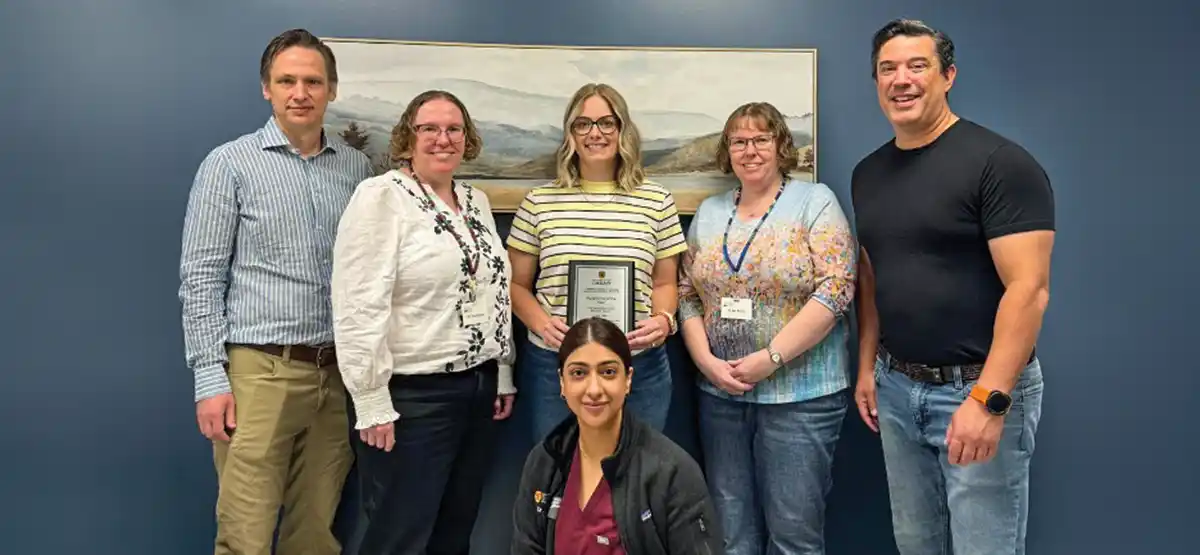
Six people pose indoors, one kneeling in front. The center person holds a framed certificate. They stand against a blue wall with a landscape painting behind them. All are smiling.

Associate Clinic wins U of C rural teaching award

Hunting trips, coaching, weekly pickup soccer — when medical residents train at Pincher Creek’s Associate Clinic, they learn more than medicine. A community-immersed approach has earned the clinic the University of Calgary’s Rural Family Medicine Clinic of the Year award for 2025-26.

The award, presented annually through the university’s Rural Family Medicine Residency Program, recognizes a clinic that provides a welcoming and supportive learning environment while modelling high-quality, comprehensive patient care.

The Associate Clinic was nominated by multiple student residents and selected from a field of several finalists by the program’s resident body.

Dr. Gavin Parker, a physician at the clinic and clinical associate professor with the U of C’s Cumming School of Medicine, says the recognition was meaningful for the entire team.

“We work very closely with a lot of the other rural sites, so we’re pretty knowledgeable about the excellent clinical work that happens across the province,” he says. “We’re certainly honoured by it.”

The award reflects a long-standing commitment to teaching and mentorship. Parker estimates the Associate Clinic has been training medical learners for more than 40 years and all seven of its physicians serve in teaching roles.

Residents and medical students rotate through a range of health-care settings including family medicine, emergency medicine, surgery, inpatient care and community-based health care. Learners also work alongside allied health professionals such as respiratory therapists, dietitians and mental health practitioners, and take part in weekly simulation training.

“We really do prioritize the learner experience in our community,” Parker says. “We’ve got a really fantastic group of physician preceptors and, equally important, we’ve got a really great staff that creates a welcoming environment for these students.”

The clinic typically hosts three to four residents at a time, with 15 to 20 completing rotations in Pincher Creek each year.

Beyond clinical training, the team encourages learners to step into local activities, from coaching youth sports to attending events and finding volunteer opportunities.

According to Parker, understanding the broader role physicians play in a rural community is an important part of medical education. That sense of connection benefits both learners and the community.

“We’ve had several of our learners coach volleyball or basketball, or get involved with Lego League or whatnot in town, and so kind of really showing them the role that physicians play in a community outside of the medical context,” he says.

That connection positively supports physician recruitment, a challenge faced by many rural communities.

“Most of the data shows that the earlier and longer that you can expose medical learners to the rural context, the more likely they are to make that as part of their career path,” Parker says.

This approach has already paid dividends locally. Several former learners have returned to work at the Associate Clinic, including current physician Dr. Ashley Rommens, who completed her residency there before joining the team.

Parker also recalls a former resident who was invited on a hunting trip by a Pincher Creek resident during their rotation and has since returned as a locum physician.

“The communities that do really well — and this is not just physicians, but nurses, allied health professionals, teachers as well — if you want to recruit those professionals, you have to make it a welcoming community,” Parker says. “It’s cliché, but it literally does take a village.”

Parker says the recognition belongs to far more than just the physicians.

“It’s massively a team effort,” he says. “It’s everybody. It’s all the way down to our reception, our schedulers, finance people, all our allied health professionals and all the other preceptors, the learners themselves and the community at large.”

He considers Pincher Creek’s supportive environment a major reason the clinic has been able to build a successful teaching program.

“It’s an awesome place to work,” he says, “and I think if it wasn’t because of the community making it such a great place to work, it’d be hard to win awards like this.”

Awards, Family Medicine, Medical Education, Physician Recruitment, Physicians | Doctors, Rural Health Care

Man and young girl in orange t-shirts wave while standing with their bicycles

Father-daughter cyclists ride to fight childhood cancer

When Arnei de Guzman moved to Canada, he struggled with homesickness and wondered if he’d made the right call. A Facebook post about the Great Cycle Challenge led to the sense of purpose he yearned for.

Each August, the national event sees riders set distance goals and raise money for childhood cancer research. Since it began in 2016, nationwide participants have ridden more than 31 million kilometres and raised more than $61 million to combat kids’ cancer.

Inspired by the cause, Arnei rode in 2021 and has never looked back.

Now taking on the challenge for a sixth consecutive year, he looks to build on the 1,144 kilometres he has ridden and $7,690 he has raised for the SickKids Foundation.

“I choose to help them because they don’t want this kind of illness,” Arnei says. “For me, that’s the only thing that I can do for them — riding my bike and asking some of my friends to do the fundraising.”

This year’s ride carries personal significance — his father-in-law is a cancer survivor and his nephew is living with metastatic cancer.

“This ride is for him,” Arnei says.

To buy his first bike, Arnei worked two jobs while settling into life in Canada. Over the years, the challenge has become about far more than cycling, giving him purpose while meeting new people and strengthening his ties to the community.

“A lot of people, a lot of the Filipino community here in town supported me, so I became motivated again,” he says.

One of his favourite memories is exploring southwestern Alberta by bicycle, especially the Waterton area, which he says made him feel alive while providing peace and purpose.

Arnei also draws inspiration from his daughter, Freya, hoping participating in the challenge will teach her the importance of helping others.

“I’m doing this because I want my little girl to see how beautiful it is to live when you’re going to help someone,” he says.

Freya is riding in the Great Cycle Challenge for a third consecutive year. To date, she has ridden 79 kilometres and raised $1,552.

“Right now, over 1,700 children are diagnosed with cancer every year and it’s the biggest killer of children from disease in Canada. Kids should be living life, not fighting for it,” Freya wrote on her rider profile.

Arnei’s mountain bike, which he says holds special sentimental value, was recently stolen and later recovered with significant damage but the setback isn’t stopping him. He plans to ride this year on his road bike.

When it was suggested community members would help him buy a replacement, he asked them to give to the fundraiser instead.

“If anyone is thinking of helping me, I would respectfully ask that you consider supporting my fundraiser instead of helping me buy a new bike,” he wrote on Facebook. “Your generosity will go directly toward helping children who are bravely fighting cancer.”

Arnei says his fundraising remains his priority because he still has another bike he can ride, while children fighting cancer need support now.

“A new bike can wait,” he says. “If people want to help me, I’d rather they donate to the fundraiser so that children with cancer can receive the medicine and care they need. If a donation can help ease a child’s pain, even for just one day, then that’s far more important to me than getting a new bike.”

He is grateful to the community for helping him recover the stolen bike.

“It meant a lot,” says Arnei. “I never thought that I could recover my bike again.”

For this year’s challenge, Arnei has set a goal of riding 100 kilometres and raising $500, with $159 raised so far. He plans to do the ride on his birthday, Aug. 7.

Freya has set a goal of riding 75 kilometres and has already raised $500 this year.

Arnei says helping people who can’t repay the kindness is reward enough for him.

“If you are going to help, you don’t need to expect anything to come back from the people that you help,” he says. “That’s why I always choose to help the people that don’t have the capability to give back that help.”

More information about Arnei and Freya’s Great Cycle Challenge, including how to donate, is available online through their rider profiles at greatcyclechallenge.ca.

Cancer Survivors, Childhood Cancer Research, Community Support, Cycling, Fundraising, Great Cycle Challenge

A woman with blonde hair and glasses smiles as she holds up a children's picture book

Around the world in six weeks at the Pincher Creek library

This summer, a missing animal is waiting to be found in Prince Edward Island, then Hawaii, Australia, Bali and the Caribbean, and Pincher Creek children are travelling the world, one week at a time, to bring each one home.

It’s Pincher Creek Municipal Library’s own globetrotting spin on the 2026 TD Summer Reading Club, and outreach co-ordinator Samantha Bonwick builds a fresh adventure around the national theme every year.

Running July 7 to Aug. 12, the six-week program embraces this year’s national Dive In theme, which encourages children to explore waterways and aquatic life.

The TD program supplies libraries across Canada with activity books and resources, but Bonwick creates her own story around the national theme.

“We are going to a different location in the world to find that a certain species has disappeared,” she says.

“We learn about that animal and learn about what happens to that environment without that animal, and how important that animal was to the environment.”

Each week, participants travel to a different destination, beginning in Prince Edward Island and ending back home in Pincher Creek to learn about rainbow trout.

Along the way, children complete themed crafts and activities and search for the week’s missing animal. Once it’s found, they place a sticker on a habitat display, symbolically returning the species to its natural environment.

The library offers three age-based sessions:

—Ages zero to four: Wednesdays, 10:30 to 11:30 a.m.

—Ages five to seven (kindergarten to Grade 2): Tuesdays, 10:30 a.m. to noon.

—Ages eight to 11 (grades 3 to 5): Wednesdays, 1:30 to 3 p.m.

Weekly Funday Fridays are also held on the library lawn and are open to families on a drop-in basis.

Bonwick enjoys taking the annual theme and turning it into an imaginative adventure that makes learning feel less like schoolwork.

Among past adventures was chasing Bigfoot across Canada during the country’s 150th anniversary celebrations.

“There was a learning aspect and a reading aspect to it, but we do it in an adventure,” she says. “It’s in a fun way because I want them to still get it somewhere and not have to come here and do worksheets and school.”

Participants receive TD Summer Reading Club activity books to record everything they read throughout the summer, whether it’s a chapter from a novel, a recipe or anything else.

Children earn weekly prizes for tracking their reading and every completed title helps build an aquatic-themed mural on the library’s program-room window.

During each session, Bonwick also reads a picture book connected to that week’s featured destination or animal.

She hopes the club introduces new families to the library and helps children develop a lifelong appreciation for reading.

“I really love that I’ve seen kids who I’ve never met before come for the Summer Reading Club, and then I get to see them continue using the library that following year,” she says.

“I really love meeting new faces and trying to help foster that love for the library and for reading.”

The main goal is simply to keep children reading through the summer, and that doesn’t need to mean “sitting down and reading a long chapter book,” Bonwick says.

“Reading can be reading a magazine. Reading can be following a recipe. Reading can be pointing out traffic signs as you’re driving. Reading doesn’t have to be ‘Sit down, be quiet and read.’ Reading can be fun.”

Children’s Literacy, Environmental Education, Library Programs, Summer Activities, TD Summer Reading Club

The quiet force behind Pincher Creek’s arts scene

Kassandra Chancey says she has no artistic talent herself, but she takes great joy from supporting the artists and musicians who offer workshops, exhibitions, concerts and other events at Lebel Mansion, home of Pincher Creek’s Allied Arts Council.

As executive director of the arts council, Kassandra oversees gallery shows, programming and the gift shop, and manages tenants leasing space in the historic building.

“It’s the tenants paying the rent that make it possible for us to take care of the building and its operations,” she says.

They include a consignment shop, an artist studio, and offices for counsellors, massage therapists and non-profit organizations.

Kassandra grew up around artists and musicians. She and her husband moved from the East Coast to southwestern Alberta for a summer job, then returned so often they decided to make Pincher Creek their permanent home.

“I feel really lucky to have this job in a beautiful community where everyone is so supportive,” she says.

Lebel Mansion has a pottery studio open to adults who have taken a pottery workshop and can demonstrate their experience. During drop-in times, they can use tools supplied by Allied Arts, including eight pottery wheels and a kiln.

The well-known gift shop is the most forward-facing part of the council’s operations. The 65 to 70 artists whose work is on offer come through an application process Kassandra oversees.

“I look for something that is handmade and intentional,” she says.

Kassandra tries to support artists who rely on their work for a living. She also offers books on Indigenous or local topics, particularly well-made children’s books.

“I would love to read every book that we put out for sale, but sadly, I don’t have the time. I only manage to read about one out of every 10,” she says.

There is also the gallery space. The website thelebel.ca is a go-to spot for upcoming gallery exhibits, workshops and special events.

Kassandra is passionate about the services provided at the iconic building overlooking town.

“It is so important to have creative, inclusive spaces in rural communities,” she says.

Kassandra also enjoys partnering with other organizations in the region.

“We often have similar goals and values, wanting to make sure that everyone has access to arts and culture resources in places where they feel welcomed and included,” she says.

Kassandra invites people to become Allied Arts Council members for only $5 a year, which helps ensure creativity flourishes.

She reminds artists they have until Aug. 14 to submit 2027 exhibit applications. Each selected artist can display work for six to eight weeks. All disciplines are welcome, including visual arts, film and new media. Artists are paid $1,000 and, apart from the 30 per cent commission to Allied Arts, they keep the proceeds of any sales.

Art Galleries, Arts, Pottery, Visual Arts

Rod McKenzie, a new owner of Westcastle Motors, stands at the Pincher Creek dealership.

New owners take the wheel at Westcastle Motors

It is a long way from Edmonton to Pincher Creek, especially with a young family in the capital city and a new business here in town.

In December, Rod McKenzie took over as lead for a new four-person ownership team at Westcastle Motors. Having spent 20 years in the automotive industry — the last seven as general manager of another dealership — Rod took the opportunity when the previous owner looked to sell.

While he has been busy familiarizing himself with staff and learning General Motors’ sales and inventory software, his wife has been preparing to sell their Edmonton home and relocate their family to the region.

A grand opening event that brought in about 70 people Friday was a great start.

“The community here is incredible,” he says. “I couldn’t be more thankful and lucky that so many people came out to the dealership.”

Rod also speaks highly of his staff.

“They are incredible,” he says. “Transitioning between owners isn’t easy, but I feel very supported.”

Rod is taking on the venture at a time when geopolitical turmoil could greatly reduce fuel supplies. He points to the 2008 financial crisis, the Covid-19 lockdowns and other tumultuous times as previous challenges.

“There always have been and always will be some scary times. The main thing is for the community and individuals to pull together and look out for each other,” he says. “I sense that kind of attitude is alive and well here in Pincher Creek.”

Rod welcomes the community to stop by and check out vehicles on offer at Westcastle Motors and is keen for insider tips on things to see and do in the area.

Automotive Industry, Business Ownership