

Report: New study highlights water security fears in south
Report: Southern Alberta residents speak up about groundwater concerns in new report
Living Lakes Canada
With 31 water shortage advisories in effect across Alberta as of Aug. 18, water security remains a pressing concern despite above normal summer rain in southern regions. In watersheds such as the Oldman, forecasts range from average to much below average water supply, and years of severe drought have heightened these concerns.
In recent community meetings and a public survey focused on groundwater, southern Alberta residents voiced their priorities around understanding and protecting this vital freshwater source.
Co-led by Living Lakes Canada and the Oldman Watershed Council, in collaboration with the Piikani Nation Lands Department, the Alberta Groundwater Program aims to build a community-based monitoring network to strengthen groundwater management and support sustainable water use. The program blends Western science with knowledge, both Indigenous and non-Indigenous, to help identify priority locations for monitoring.

Living Lakes Canada’s Maggie Finkle-Aucoin discussing groundwater concerns with community members during the Pincher Creek public meeting. The Alberta Groundwater Program held three public meetings in spring 2025 to gather input on groundwater priorities and concerns.
Living Lakes Canada photo
Community engagement is at the heart of the program. In spring 2025, three public meetings were held in Pincher Creek, Lethbridge and online, complemented by an online survey to gather broader input. The program also engaged with the Piikani Nation community to better understand priorities and concerns. Participants represented a range of backgrounds and sectors, including educators and non-profit workers, agriculture and land use managers, Indigenous leaders and government.
The feedback revealed strong, region-wide concern about groundwater. More than 70 per cent of survey respondents said they are “very concerned” about groundwater in Alberta, and a combined 97 per cent said improving understanding of groundwater is either “very important” or “important.”
Top concerns from both the meetings and survey included drinking water access, contamination risks from industry (such as oil, gas and mining), water use for irrigation and livestock, and ecosystem health.
“We are in a drought cycle. There is very little snowpack in the mountains to recharge the groundwater, possibly affecting our only water source. As a primary producer, water is essential for our animals, household and gardens,” said one participant.
Meeting participants were invited to mark locations of concern on watershed maps. Hotspot areas of concern include Pincher Creek, Crowsnest Pass, Lethbridge and extend through other communities such as Stavely, Vulcan, Cardston and Twin Butte.
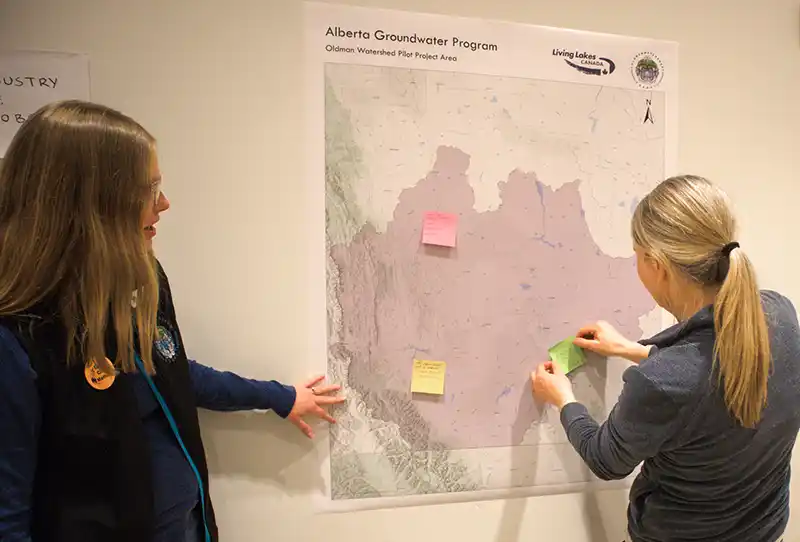
Shannon Frank, executive director of the Oldman Watershed Council, alongside a community member during the groundwater mapping exercise in Lethbridge. Participants marked locations of concern on watershed maps as part of the Alberta Groundwater Program’s community engagement process.
Living Lakes Canada photo
“Our community has minimal information on groundwater availability to support our long-term community needs,” said another participant.
Lethbridge-based Anne-Marie Lefebvre, Living Lakes Canada’s Alberta Groundwater Program co-ordinator, emphasized the commitment to water stewardship:
“People in this region are deeply passionate about safeguarding water for future generations. Ranchers, farmers and entire communities’ livelihoods depend upon a reliable and secure water supply. This project helps to link science and community water security needs and priorities for the long-term.”
Based on the input received through the public engagement process, Living Lakes Canada and the Oldman Watershed Council is developing a shortlist of monitoring well sites using both community-identified priorities and scientific criteria, including findings from the aquifer vulnerability assessment and data gap analysis.
Final site selection is expected in late summer or early fall 2025, followed by the launch of monitoring and community workshops.
Read the full community engagement report at www.livinglakescanada.ca/abgroundwater.
Shootin’ the Breeze welcomes your voice.
The Breeze Mailbox is a space for sharing thoughts, stories, and conversations about what matters locally — from letters and opinion pieces to news releases and reader notes.
The views expressed here are personal and don’t necessarily reflect those of our team or ownership, but we believe in making space for respectful dialogue and community perspective.
Submission guidelines:
- Keep it under 800 words
- Include your full name and contact info
- Be respectful and constructive
We reserve the right to edit for clarity, length and tone
Have something to share? We’d love to hear from you. Send your submission to publisher@shootinthebreeze.ca.


Southwest Alberta News, Features and Events
-
 Fort Macleod ER closed tonight, Pincher Creek among backups
-
 Aspen Wilson located safe, Valleyview RCMP cancel Amber Alert
-
 Travelling Library a hit with Piikani children and elders
-
 Checks, balances and one Canada
-
 Randy Plain Eagle brings his story and his stage home
-
 Thirty years on, Irene Hollander still walks for Terry Fox
-
 Daughter shares Rose Potts’s residential school story at Vista Village
-
 Allison Creek camp asks for pause on West Fraser harvest
-
 Residents seeking time with town council face new rules
-
 Shootin’ the Breeze Newspaper — Sept. 30, 2026
-
 A Piikani mother puts one foot in front of the other for her daughter
-
 ‘We walk for those who cannot walk beside us’


Southwest Alberta Municipal News


Government of Alberta News

Alberta RCMP

Obituaries
Opinions

Report: New study highlights water security fears in south
Report: Southern Alberta residents speak up about groundwater concerns in new report
Living Lakes Canada
With 31 water shortage advisories in effect across Alberta as of Aug. 18, water security remains a pressing concern despite above normal summer rain in southern regions. In watersheds such as the Oldman, forecasts range from average to much below average water supply, and years of severe drought have heightened these concerns.
In recent community meetings and a public survey focused on groundwater, southern Alberta residents voiced their priorities around understanding and protecting this vital freshwater source.
Co-led by Living Lakes Canada and the Oldman Watershed Council, in collaboration with the Piikani Nation Lands Department, the Alberta Groundwater Program aims to build a community-based monitoring network to strengthen groundwater management and support sustainable water use. The program blends Western science with knowledge, both Indigenous and non-Indigenous, to help identify priority locations for monitoring.
Living Lakes Canada’s Maggie Finkle-Aucoin discussing groundwater concerns with community members during the Pincher Creek public meeting. The Alberta Groundwater Program held three public meetings in spring 2025 to gather input on groundwater priorities and concerns.
Living Lakes Canada photo
Community engagement is at the heart of the program. In spring 2025, three public meetings were held in Pincher Creek, Lethbridge and online, complemented by an online survey to gather broader input. The program also engaged with the Piikani Nation community to better understand priorities and concerns. Participants represented a range of backgrounds and sectors, including educators and non-profit workers, agriculture and land use managers, Indigenous leaders and government.
The feedback revealed strong, region-wide concern about groundwater. More than 70 per cent of survey respondents said they are “very concerned” about groundwater in Alberta, and a combined 97 per cent said improving understanding of groundwater is either “very important” or “important.”
Top concerns from both the meetings and survey included drinking water access, contamination risks from industry (such as oil, gas and mining), water use for irrigation and livestock, and ecosystem health.
“We are in a drought cycle. There is very little snowpack in the mountains to recharge the groundwater, possibly affecting our only water source. As a primary producer, water is essential for our animals, household and gardens,” said one participant.
Meeting participants were invited to mark locations of concern on watershed maps. Hotspot areas of concern include Pincher Creek, Crowsnest Pass, Lethbridge and extend through other communities such as Stavely, Vulcan, Cardston and Twin Butte.
Shannon Frank, executive director of the Oldman Watershed Council, alongside a community member during the groundwater mapping exercise in Lethbridge. Participants marked locations of concern on watershed maps as part of the Alberta Groundwater Program’s community engagement process.
Living Lakes Canada photo
“Our community has minimal information on groundwater availability to support our long-term community needs,” said another participant.
Lethbridge-based Anne-Marie Lefebvre, Living Lakes Canada’s Alberta Groundwater Program co-ordinator, emphasized the commitment to water stewardship:
“People in this region are deeply passionate about safeguarding water for future generations. Ranchers, farmers and entire communities’ livelihoods depend upon a reliable and secure water supply. This project helps to link science and community water security needs and priorities for the long-term.”
Based on the input received through the public engagement process, Living Lakes Canada and the Oldman Watershed Council is developing a shortlist of monitoring well sites using both community-identified priorities and scientific criteria, including findings from the aquifer vulnerability assessment and data gap analysis.
Final site selection is expected in late summer or early fall 2025, followed by the launch of monitoring and community workshops.
Read the full community engagement report at www.livinglakescanada.ca/abgroundwater.
Shootin’ the Breeze welcomes your voice.
The Breeze Mailbox is a space for sharing thoughts, stories, and conversations about what matters locally — from letters and opinion pieces to news releases and reader notes.
The views expressed here are personal and don’t necessarily reflect those of our team or ownership, but we believe in making space for respectful dialogue and community perspective.
Submission guidelines:
- Keep it under 800 words
- Include your full name and contact info
- Be respectful and constructive
We reserve the right to edit for clarity, length and tone
Have something to share? We’d love to hear from you. Send your submission to publisher@shootinthebreeze.ca.

You must be logged in to post a comment.
Southwest Alberta News, Features and Events
- Fort Macleod ER closed tonight, Pincher Creek among backups
- Aspen Wilson located safe, Valleyview RCMP cancel Amber Alert
- Travelling Library a hit with Piikani children and elders
- Checks, balances and one Canada
- Randy Plain Eagle brings his story and his stage home
- Thirty years on, Irene Hollander still walks for Terry Fox
- Daughter shares Rose Potts’s residential school story at Vista Village
- Allison Creek camp asks for pause on West Fraser harvest
- Residents seeking time with town council face new rules
- Shootin’ the Breeze Newspaper — Sept. 30, 2026
- A Piikani mother puts one foot in front of the other for her daughter
- ‘We walk for those who cannot walk beside us’
Alberta and Beyond News, Features and Events
-
 Community celebrates completion of Allison Falls Trail
-
 Adaptable Outdoors wraps season with 300 experiences delivered
-
 Pincher Creek area under fire restriction
-
 Park Guardian Program supports clean green spaces
-
 Bear advisory issued for Alberta’s backcountry and outdoor areas
-
 Volunteers drive Star Creek Trail upgrades for improved hiking experience in Crowsnest Pass
-
 Heed the heat — tips to keep dogs cool and hydrated
-
 Crowsnest to see hiking trail improvements this summer
-
 Safe adventuring
-
 Summer paddling opportunities
-
 Take river safety seriously
-
 Alberta Conservation reminds us to be bear smart


Southwest Alberta Municipal News
Government of Alberta News
Alberta RCMP
Obituaries
You must be logged in to post a comment.