Province: Manitoba | MB

Logo with the word "Alberta" in stylized script above a blue banner that says "Government News and Notices" in white uppercase letters.

Privacy regulators discuss AI, cybersecurity at Banff meeting

Federal, provincial and territorial information and privacy commissioners concluded their annual meeting in Banff on Oct. 10, focusing on emerging issues related to artificial intelligence, cybersecurity and health data protection.

The two-day meeting, hosted by the Information and Privacy Commissioner of Alberta, brought together regulators and ombuds with responsibilities under access and privacy laws, according to a government news release.

AI and online harms

Emily Laidlaw, a Canada Research Chair in cybersecurity law and associate professor at the University of Calgary Faculty of Law, presented on online harms and the information ecosystem, covering AI, protection of children, misinformation and disinformation, freedom of expression and human-centric cybersecurity.

Health data storage

Michael Geist, Canada Research Chair in Internet and E-Commerce Law at the University of Ottawa, addressed the use of servers outside Canada to store health data of Canadians. He discussed whether data localization should be regulated under privacy or other laws in Canada.

Cybersecurity threats

Daniel Couillard and Richard Larose, both with the Canadian Centre for Cyber Security, provided an overview of their agency’s roles and mandate. They shared insights from the National Cyber Threat Assessment 2025-2026 and discussed opportunities for mutual support as privacy regulators continue dealing with massive data breaches caused by cybersecurity attacks.

AI in healthcare and tribunals

Paul Daly, chair in administrative law and governance at the University of Ottawa, discussed the use of AI by administrative tribunals, describing potential advantages and disadvantages.

Ross Mitchell, a professor in the Department of Medicine and adjunct professor in computer science at the University of Alberta and a fellow at the Alberta Machine Intelligence Institute, provided an overview of deep learning applications to healthcare. He addressed the use of AI scribes to record and transcribe physician conversations with patients and how to consider privacy rights in this context.

Legislative updates

Meeting participants discussed recent developments and expected changes to access and privacy laws across Canada, as well as key court decisions with implications for access and privacy.

“Our offices work collaboratively year-round on issues relating to privacy and access to information,” says Diane McLeod, Information and Privacy Commissioner of Alberta. “Our annual meeting offers the opportunity to spend time together in person to discuss emerging issues, share insights and experiences, and strengthen our joint commitment to protecting the access and privacy rights of all Canadians.”

McLeod says the work addresses critical issues facing individuals, communities, governments, organizations, businesses and society at large, many relating to challenges of digital technology.

“Most of us live much of our lives online, and while this brings benefits, it also presents privacy risks,” she says.


Alberta | AB, Artificial Intelligence | AI, Cybersecurity, Information and Privacy

A cowboy wearing a hat and a numbered shirt rides a white horse in a rodeo arena, preparing to throw a lasso. An official in a white shirt and hat stands nearby.

Tie-down ropers neck-and-neck heading into CFR finale

The Canadian Finals Rodeo heads into its final two rounds Saturday with the tie-down roping championship up for grabs.

Kyle Lucas of Carstairs and Beau Cooper of Stettler turned in identical 7.6-second runs — the fastest of the week — and both remain in contention. Stran Dunham of Souris, Man., leads with $54,137, holding a $7,000 edge over Cooper in second place at $47,501. Lucas sits third, just $2,000 back of Cooper.

“All three rounds have been good rounds with really good roping,” Cooper says. “It’s all been pretty tight and everybody’s roping good.”

Lucas credits his horse and preparation. “I think the hardest thing is to let go and trust your preparation and your training,” he says. “I’m riding Bunny (Lola) here at the CFR. Tim Bagnell let me take that horse and that’s kind of his baby. I’m just very fortunate to get to take her.”


A cowboy wearing a white shirt and hat rides a rearing gray horse in a rodeo arena, holding a lasso, with dirt flying and spectators in the blurred background.

Kyle Lucas – Photo by Billie Jean Duff

In bull riding, two-time champion Jared Parsonage has seized control with a perfect three-for-three performance. The Maple Creek cowboy is the only bull rider to conquer all three bulls so far and leads with $56,420 over season leader Jake Gardiner’s $52,820. Parsonage captured second place Friday with an 87.5-point ride on Trailer Trash. He also leads the aggregate with 256.75 points on three.

Event flyer for The Hometown Holiday Market on November 14, 2026, at the Heritage Inn in Pincher Creek, featuring a list of vendors and event details set against a snowy holiday background.

Round 3 winners:

  • Bareback: Dantan Bertsch, 86.75 points
  • Steer wrestling: Scott Guenthner, 3.6 seconds (third consecutive round win)
A rodeo competitor wearing a pink shirt and hat rides a horse while swinging a lasso toward a running calf in an indoor arena, with spectators and signage visible in the background.

Caitlyn Dahm – Photo by Covy Moore

  • Breakaway roping: Caitlyn Dahm, 1.9 seconds
A rodeo cowboy wearing a hat and maroon shirt rides a bucking horse in an indoor arena, surrounded by spectators and judges. The horse is mid-jump, with its legs raised and mane flying.

Ben Andersen – Photo by Covy Moore

  • Saddle bronc: Ben Andersen, 88 points
  • Barrel racing: Pamela Morrison, 13.84 seconds (first CFR round win)

A rodeo competitor rides a galloping horse in an arena, wearing a white shirt and black cowboy hat. The horse has blue protective leg wraps. Rodeo staff and spectators watch in the background.

Kash Bonnett – Covy Moore Photo

A rodeo cowboy wearing a black hat rides a galloping horse, swinging a lasso in an indoor arena. Spectators and event staff watch in the background. The image is credited to Covy Moore.

Logan Cullen – Photo by Covy Moore

  • Team roping: Kash Bonnett/Logan Cullen, 4.5 seconds (second consecutive round win)
  • Bull riding: Grady Young, 88.25 points
A rodeo cowboy in a red shirt and black hat rides a bucking horse in an arena, gripping the reins as the horse leaps. Spectators and officials watch from behind a metal fence.

Quaide Skjonsberg – Photo by Covy Moore

  • Novice bareback champion: Quaide Skjonsberg

A woman sorts food items into cardboard boxes at a food bank, with text above advertising Vision Credit Union’s Helping Hand Grants, which offer up to $10,000 for rural Alberta non-profits, with a QR code and an application deadline of January 17, 2027.

A rodeo rider wearing a helmet and vest rides a bucking horse inside an arena as the horse kicks up its hind legs; rodeo officials and onlookers stand behind the fence in the background.

Clay Greenslade – Photo by Covy Moore

  • Novice saddle bronc champion: Clay Greenslade

CFR 51 rounds four and five start at 11 a.m. and 6:30 p.m. Saturday at Rogers Place in Edmonton. Complete results at rodeocanada.com.

Three people in cowboy hats pose together at a rodeo event; the woman in the center wears a sash reading “Miss Rodeo Canada 2022” and a crown, while the man on the left holds a belt buckle award.

Abbey Harty – Miss Rodeo Canada – Photo by Billie Jean Duff


Alberta | AB, Beau Cooper – Stettler, British Columbia, Canadian Finals Rodeo | CFR, Carstairs – Alberta, Edmonton – Alberta, Fort St. John – British Columbia, Jake Gardiner – Fort St. John, Jared Parsonage – Maple Creek, Kyle Lucas – Carstairs, Manitoba, Maple Creek – Saskatchewan, Provost – Alberta, Saskatchewan, Scott Guenther – Provost, Souris – Manitoba, Stettler – Alberta, Stran Dunham – Souris

Transparent padlock icons connected by lines overlay a blurred background of people and city buildings, symbolizing cybersecurity, data protection, and secure digital connections.

Ministers sign cybersecurity pact in Kananaskis

Federal, provincial and territorial ministers signed a cybersecurity collaboration agreement in Kananaskis to better protect Canada’s critical infrastructure and personal information.

The Sept. 23 FPT Ministerial Symposium on Digital Trust and Cyber Security brought together ministers to discuss building and protecting Canada’s digital economy. Alberta’s Technology and Innovation Minister Nate Glubish hosted the meeting.

The agreement aims to prevent cybersecurity events that may affect information confidentiality or availability. It allows governments to share real-time intelligence on cyber threats plus cybersecurity tools and services.

Intelligence sharing and response

The collaboration builds on discussions from the 2024 FPT Symposium, which focused on sharing information to respond quickly to cyber attacks. Ministers stressed increased government collaboration to address existing and emerging threats.

They also highlighted organizing a pan-Canadian tabletop exercise to enhance the country’s resilience to cyber attacks. However, no timeline was provided for this initiative.

Parliamentary Secretary Jenna Sudds, representing the federal government, said the agreement means stronger digital infrastructure. This allows communities to connect and do business securely.

Job ad for “Shootin’ the Breeze” seeks part-time and full-time staff for photography, writing, and reporting; contact publisher@shootinthebreeze.ca. Background shows printed news text and a hand holding a voice recorder.

Digital infrastructure priorities

Ministers discussed making it easier for people and businesses to connect across urban, rural and remote areas through digital infrastructure projects. They underlined the importance of publicly available digital infrastructure to help individuals and governments participate in the digital economy.

Ontario Minister Stephen Crawford said the collaboration addresses “complex and evolving challenges of our digital age.” It strengthens digital infrastructure while supporting Canadian innovation.

Supply chain and AI focus

Ministers noted the need to diversify hardware and software supply chains to support digital sovereignty. They acknowledged cybersecurity risks in procurement while committing to make buying easier and more accessible. They also want to strengthen government purchasing power in information technology.

They discussed artificial intelligence’s role in reshaping everything from automating tasks to enabling disease detection. Ministers pledged to leverage existing work and share open-source technology so governments have compatible AI tools.

Quebec Minister Gilles Bélanger noted his province’s active approach, including a 2023 collaboration agreement with British Columbia on digital identity services. Quebec also has a cybersecurity pact with Communications Security Establishment Canada.

Provincial perspectives

Several ministers highlighted the co-ordinated approach to digital challenges. Manitoba’s Mike Moroz pointed to expanding collaboration with municipal partners to protect critical services. British Columbia’s Diana Gibson noted that “no single government can face” complex cyber threats alone.

Saskatchewan Minister David Marit called the agreement “a pivotal advancement in safeguarding our citizens and businesses from cyber threats.”

Officials from Newfoundland and Labrador plus Nunavut attended as observers due to ongoing elections in those jurisdictions.

Alberta | AB, Artificial Intelligence | AI, British Columbia, Cybersecurity, Digital Economy, Digital Identity, Labrador & Newfoundland, Manitoba, Nate Glubish – Government of Alberta, Northwest Territories, Nova Scotia, Nunavut, Ontario, Prince Edward Island, Saskatchewan, Technology, Yukon

Three white envelopes blow in the wind in front of an open grey mailbox on the heading for Shootin' the Breeze Mailbox articles and letters to the editor.

News associations challenge Canada Post over community newspaper delivery

News associations respond to CUPW and Canada Post halting of delivery of unaddressed community newspapers

Letter:

On Sept. 16, multiple news publishing associations sent the following letter to Canada Post CEO Doug Ettinger and Canadian Union of Postal Workers president Jan Simpson:

On behalf of the members of the Alberta Weekly Newspapers Association, B.C. & Yukon Community News Media Association, Hebdos Québec, Manitoba Community Newspapers Association, National Ethnic Press and Media Council of Canada, News Media Canada, Ontario Community Newspapers Association and Saskatchewan Weekly Newspapers Association, we are writing to express our extreme disappointment in both Canada Post and CUPW.

Both of you are treating unaddressed community and ethnic newspapers like “junk mail.”

Mr. Ettinger, your decision to no longer exempt community newspapers with commercial inserts from Canada Post’s Consumers’ Choice program effectively treats fact-based, fact-checked Canadian journalistic content as “junk mail.” You made that decision without proper stakeholder consultation or economic/social impact analysis.

Ms. Simpson, your recent decision to neither process nor deliver unaddressed flyers (Neighbourhood Mail) — whether intended or not — is holding community newspaper publishers hostage and is depriving Canadians of fact-based, fact-checked community news.

Get Stuff’d meat and seafood shop sign, located at 214 13th St. in Fort Macleod, open Thursday through Saturday from 12 noon to 6 p.m., phone 368-996-1968, follow us on Facebook at Get Stuff’d.

Community and ethnic newspapers keep Canadians informed, engaged and connected in hundreds of communities across Canada. Many are small businesses, owned by local entrepreneurs, who are struggling just to keep the lights on and make payroll in the face of the loss of advertising to American big tech companies.

Let us be clear: community newspapers, with or without commercial inserts, are not “junk mail”; they are a vital source of information for Canadians. Our members are good paying customers of Canada Post, and we resent this shabby treatment. As you work out your differences, we hope both sides will bargain in good faith, and we call on the two of you to ensure that the processing and delivery of unaddressed community newspapers — with or without commercial inserts — resumes immediately.

Thank you for your urgent attention to this matter.

While this action doesn’t directly affect Shootin’ the Breeze subscribers, it impacts a number of Alberta newspapers whose publications are distributed through the Canada Post Neighbourhood Mail program.


Shootin’ the Breeze welcomes your voice.

The Breeze Mailbox is a space for sharing thoughts, stories, and conversations about what matters locally — from letters and opinion pieces to news releases and reader notes.

The views expressed here are personal and don’t necessarily reflect those of our team or ownership, but we believe in making space for respectful dialogue and community perspective.

Submission guidelines:

  • Keep it under 800 words
  • Include your full name and contact info
  • Be respectful and constructive

We reserve the right to edit for clarity, length and tone

Have something to share? We’d love to hear from you. Send your submission to publisher@shootinthebreeze.ca.

Alberta | AB, Alberta Media, Alberta Newspapers, Alberta Weekly Newspapers Association | AWNA, BC and Yukon Community News Media Association, BC Newspapers, British Columbia, Canada Post, Ethnic Newspapers, Hebdos Quebec, Manitoba, Manitoba Community Newspapers Association, Manitoba Newspapers, National Ethnic Press and Media Council of Canada, News Media Canada, Ontario, Ontario Community Newspapers Association, Ontario Newspapers, Quebec, Quebec Newspapers, Saskatchewan, Saskatchewan Newspapers, Saskatchewan Weekly Newspapers Association, Yukon, Yukon Newspapers

A brain-shaped wooden puzzle lies on a dark surface, with one piece missing and placed nearby, symbolizing problem-solving or mental challenges.

PT ministers unite on addiction service gaps

Provincial and territorial ministers responsible for mental health and addiction met Sept. 22 in Banff to address service gaps and strengthen collaboration on mental health priorities across Canada.

A Government of Alberta report says the ministers committed to collaborative action on several key areas including building system capacity, sharing approaches for individuals who may pose risks to themselves or others, and seeking long-term federal funding partnerships.

Alberta’s Mental Health and Addiction Minister Rick Wilson chaired the meeting and will lead a new Provincial-Territorial Forum of Ministers Responsible for Mental Health, Addiction and Recovery created during the session.

Key collaboration priorities

Ministers agreed to continue building mental health and addiction system capacity to address service gaps and strengthen primary and acute care supports. They will share information and approaches to support individuals with serious substance use or mental health issues.

The ministers committed to working with Indigenous governments and Indigenous-led organizations to advocate for appropriate federal funding. They noted Indigenous communities continue being disproportionately impacted by mental health and addiction issues, particularly the addiction crisis.

An older couple smiles while leaning on a wooden railing outdoors, above text describing their $879 profit share from Vision Credit Union and a website link.

They will seek meaningful and long-term funding partnerships with the federal government, including renewal of existing mental health bilateral agreements. Ministers also want capital and operational investments to better support individuals with complex mental health or addiction issues.

Federal advocacy efforts

The group will advocate for federal collaboration and funding for integrated youth services while respecting models developed by each province and territory. They want approaches focused on child and youth needs with increased emphasis on early intervention.

Ministers will also advocate for federal research funding through pan-Canadian Health Organizations. They want this funding aligned with provincial and territorial priorities to ensure research drives evidence-based service delivery meeting regional needs.

New forum structure

The new provincial-territorial forum recognizes the need for increased discussion and collaboration on policies and programs addressing mental health and addiction issues. It will focus on moving individuals towards recovery across the continuum of care.

Wilson emphasized the importance of continued federal partnership in sustaining and expanding community services.

“We are united in our commitment to improving mental health and addiction outcomes for all Canadians,” Wilson said. “By working together and aligning our efforts, we can strengthen supports, close service gaps, and ensure that all Canadians — especially those most at risk — receive the care they need.”


Addiction Services – Alberta, Alberta | AB, British Columbia, Health, Health Care, Indigenous Health, Labrador & Newfoundland, Manitoba, Mental Health, Mental Health Services, Northwest Territories, Nova Scotia, Nunavut, Ontario, Prince Edward Island, Rick Wilson – Government of Alberta, Saskatchewan, Yukon

Victoria Hilliard, 29, wanted on Canada-wide warrant for second-degree murder in Fort McMurray homicide case

Victoria Hilliard wanted for Mark O’Keefe murder

Wood Buffalo RCMP have charged a 29-year-old woman with second-degree murder in connection with the Dec. 12, 2023, homicide of 42-year-old Mark O’Keefe in Fort McMurray.

Police obtained a Canada-wide warrant for Victoria Sheila Elizabeth Hilliard’s arrest and are asking for public assistance in locating her.

The Alberta RCMP Major Crimes Unit laid the murder charge almost two years after O’Keefe’s death was initially reported as suspicious. On Dec. 12, 2023, at 10:10 a.m., Wood Buffalo RCMP responded to a call about a suspicious death on Parsons Access Road near the Highway 63 turn off. Shortly after, police received a call about a vehicle fire on Tower Road, which investigators believed was related to the death.

Hilliard is described as having a fair complexion, blonde hair (though she changes hair colour frequently), blue eyes and standing five feet seven inches tall. She weighs 139 pounds and has several tattoos including a mermaid on her left wrist, butterflies on her left forearm and a triple moon on her upper left forearm.

Police believe Hilliard is currently in the greater Toronto area. If seen, do not approach her and call 911 or your local police immediately.

Mark O’Keefe was originally from Placentia, Newfoundland. According to family members who spoke to media in December 2023, he was struggling with mental health and addiction issues and went missing shortly before his death. His mother told Newfoundland media that he had been desperately looking for cash to pay off drug debts when he disappeared.

Anyone with information regarding Victoria Hilliard’s whereabouts should contact Wood Buffalo RCMP at 780-788-4000 or 310-RCMP (7267).

Those wishing to remain anonymous can contact Crime Stoppers at 1-800-222-8477 (TIPS), online at www.P3Tips.com, or by using the P3 Tips app available through the Apple App or Google Play stores.


Read More from Alberta RCMP

Missing persons, crime, accidents, fire, death investigations and more.

RCMP Crime Map

View approximate locations of thefts, break and enters, missing persons and high-crime areas in Alberta here.

If you see a crime in progress or need police assistance in an emergency, call 911.

Anonymous reporting through Crime Stoppers and cash rewards

Crime Stoppers allows tip sharing without disclosing personal information. An ID number and password are provided to follow up on tip status or add details.

Cash rewards up to $2,000 may be available for tips leading to an arrest. Higher payouts apply to serious crimes like murder, sexual assault, drug and weapon seizures, and human trafficking.

Call in your tip: 1-800-222-8477 Submit tip online

Online crime reporting (under $5,000)

If you are the victim of property crime such as theft or vandalism under $5,000, online reporting is available 24/7.

Contact your local RCMP or Crime Stoppers with information about illegal activity.

Alberta | AB, Crime, Death Investigations | Homicides, Fort McMurray – Alberta, Newfoundland and Labrador, Ontario, Placentia – Newfoundland and Labrador, Toronto – Ontario, Wanted Persons

Project Cerberus logo featuring three-headed dog design for ALERT drug investigation

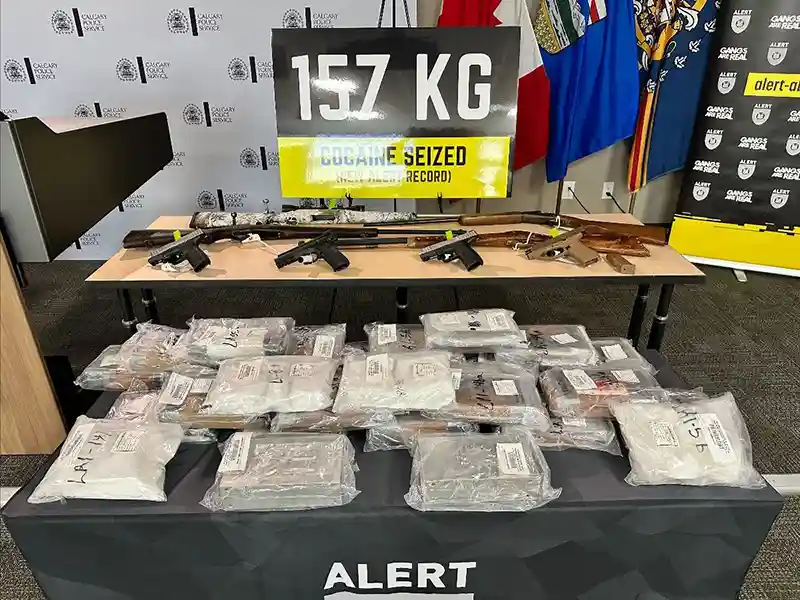
Alberta’s largest cocaine seizure nets 157 kg in bust

Alberta Law Enforcement Response Teams dismantled a major cross-border drug trafficking network with ties to Mexican cartels following a two-year investigation, resulting in one of Alberta’s largest drug seizures.

Project Cerberus, led by ALERT Calgary’s organized crime team, concluded in September with charges against five suspects. The investigation involved the U.S. Drug Enforcement Administration, Calgary Police Service and various RCMP units.

The operation began in May 2023 and uncovered an organized crime group trafficking drugs between Canada and the United States. Police seized 157 kilograms of cocaine with an estimated street value of over $15 million. The cocaine tested at 96 to 98 per cent purity, marking ALERT’s largest cocaine seizure.

Investigators also seized 15 firearms, nearly one million dollars in cash and seven vehicles equipped with hidden compartments for drug smuggling operations.

The crime group allegedly procured cocaine from Mexican cartels and imported it into Canada. They then transported the drugs across the country using vehicles with sophisticated hidden compartments.

In March 2024, Manitoba’s Roving Traffic Unit seized 61 kilograms of cocaine from a hidden compartment near Richer, Man. Then, in October 2024, the DEA seized 96 kilograms of cocaine from a Houston home identified through ALERT’s investigation.

Ace of spades card on ad for Chase the Ace at the Pincher Creek Legion

Jack Kasjaniuk, 35, of Edmonton was arrested in Houston and charged with possession with intent to distribute. He pleaded guilty and received a 135-month federal prison sentence on Sept. 8.

Over 450 investigators and civilian staff participated in the investigation. They executed 15 search warrants across Canada, targeting homes in Calgary, Edmonton, Spruce Grove and the Toronto area.

Five men face a total of 31 criminal charges related to organized crime, conspiracy, money laundering and drug offences:

Reza Muhammad, 26, of Calgary; Jordan Plamondon, 40, of Spruce Grove; Ji Hwan Kim, 34, of Calgary; Allan Leung, 33, of Edmonton; and James Morrissette, 33, of Edmonton.

All suspects have been released from custody for court appearances scheduled between Sept. 26 and Oct. 3, in Calgary.

The investigation involved multiple agencies including Calgary and Edmonton police services, various RCMP units, Canada Border Services Agency and the DEA.


Additional cocaine packages and assault rifles seized during Project Cerberus drug investigation

More evidence from Project Cerberus including cocaine packages and assault-style weapons seized during the investigation.

ALERT displays 157 kilograms of seized cocaine packages and firearms from Project Cerberus investigation

Evidence from Project Cerberus shows 157 kilograms of cocaine and firearms seized in Alberta’s largest cocaine bust.


Read More from Alberta RCMP

Missing persons, crime, accidents, fire, death investigations and more.

RCMP Crime Map

View approximate locations of thefts, break and enters, missing persons and high-crime areas in Alberta here.

If you see a crime in progress or need police assistance in an emergency, call 911.

Anonymous reporting through Crime Stoppers and cash rewards

Crime Stoppers allows tip sharing without disclosing personal information. An ID number and password are provided to follow up on tip status or add details.

Cash rewards up to $2,000 may be available for tips leading to an arrest. Higher payouts apply to serious crimes like murder, sexual assault, drug and weapon seizures, and human trafficking.

Call in your tip: 1-800-222-8477 Submit tip online

Online crime reporting (under $5,000)

If you are the victim of property crime such as theft or vandalism under $5,000, online reporting is available 24/7.

Contact your local RCMP or Crime Stoppers with information about illegal activity.

Alberta | AB, Alberta Law Enforcement Response Teams | ALERT, Calgary – Alberta, Canada Border Services Agency | CBSA, Crime, Edmonton – Alberta, Manitoba, Ontario, Richer – Manitoba, Spruce Grove – Alberta, Toronto – Ontario

A person uses a blood glucose meter to check their blood sugar, holding a test strip to a finger with a drop of blood. Lancets and extra test strips are on a blue surface.

Health coalitions call on Liberals to fulfill pharmacare promises

Health coalitions across Canada call on the federal Liberal government to fulfill its pharmacare promises as the party’s caucus prepares to meet in Edmonton next week.

Ten provincial health coalitions issued a joint statement Thursday expressing concern that progress on national pharmacare has stalled since the spring federal election. The groups note that no new agreements have been signed with provincial or territorial governments despite campaign promises to continue implementing the program.

“The federal Liberal caucus is meeting for their pre-session retreat in Edmonton next week,” the statement reads. “Before they gather, we want to remind them that during the recent federal election they repeatedly promised continued action on implementing Pharmacare.”

The coalitions argue that many Canadians voted for the Liberals based on pharmacare commitments and expect those promises to be fulfilled. They point to growing anxiety over rising living costs, including potential impacts from new tariffs on jobs, health benefits and drug costs.

National pharmacare legislation became law earlier this year, establishing a framework for the program. Four jurisdictions have signed agreements to implement it so far, providing access to contraceptives and diabetes medications and devices.

The health advocates want the Liberal government to ensure all Canadians in every province and territory have equal access to these medications. They describe anything less than a clear commitment to implementing national pharmacare as “simply unacceptable.”

The joint statement comes from health coalitions in British Columbia, Manitoba, Ontario, New Brunswick, Nova Scotia, Prince Edward Island, Saskatchewan, Alberta’s Friends of Medicare, the Canadian Health Coalition and Quebec’s Coalition solidarité santé.

The federal government has faced pressure to expand pharmacare coverage while managing competing fiscal priorities and negotiations with provinces over healthcare funding.

Alberta | AB, British Columbia, Health, Health Care, Labrador and Newfoundland, Manitoba, New Brunswick, Northwest Territories, Nova Scotia, Nunavut, Ontario, Pharmacare, Politics, Prince Edward Island, Quebec, Saskatchewan, Yukon

A rolled-up newspaper with the headline "Economics" lies on a white surface next to a pair of eyeglasses and a white coffee cup.

Think tank says Canada needs new economic model beyond tariff concerns

A new report from Canada’s C.D. Howe Institute warns that U.S. tariffs have exposed deeper economic weaknesses that have been undermining the country for years.

The report, titled “Shaken by Tariffs, Still Weak from Within: Canada Needs a New Economic and Fiscal Model,” argues that Canada’s economic struggles go far beyond trade disputes. Author Don Drummond, a fellow at the institute and Queen’s University, points to sluggish productivity growth, mounting public debt and a tax system that discourages investment as fundamental problems.

Canada’s GDP per capita has fallen from above the OECD average to merely matching it, and projections show the country will have the weakest per-capita growth among developed nations through 2060. Business investment in machinery, equipment and intellectual property lags significantly behind U.S. levels, while research and development remains weak.

The fiscal picture adds another layer of concern. Both federal and provincial governments carry heavy debt loads, and Canada’s tax structure relies too heavily on income and profit taxes rather than consumption taxes that economists consider less harmful to growth.

Announcement for Family Violence Prevention Month flag raising event on November 17 at 10 a.m. outside the Pincher Creek Library, hosted by the Pincher Creek Women’s Emergency Shelter Association.

Drummond argues that Prime Minister Mark Carney’s promised economic transformation will struggle without addressing these underlying issues. Plans to boost domestic production, develop Canadian expertise and expand into new markets will falter unless productivity and competitiveness improve and internal trade barriers disappear.

“Canada faces a crisis emanating from the US tariff threat – but it should not distract us from the deeper, longer-standing weaknesses that continue to undermine our economy,” Drummond says. The country must diversify and build resilience while tackling “the baggage we have carried for a long time.”

The report comes as Canada grapples with uncertainty over its trade relationship with the United States, which remains its largest trading partner. While tariffs grab headlines, the institute suggests the real challenge lies in fixing structural problems that have been building for decades.

The C.D. Howe Institute describes itself as Canada’s most influential think tank, focusing on economically sound public policy research.


Alberta | AB, Economics, General Interest, Tariffs