Organization: Blackfoot Confederacy

Two people stand in tall grass holding a red MMIWM Spirited+ banner near a Welcome to British Columbia sign.

‘We walk for those who cannot walk beside us’

Stephanie English of Piikani Nation brought the following statement to Shootin’ the Breeze before setting out Sept. 20 on this year’s Calling My/Our Spirit Back Unity Walk. Inspired by the deaths of two of Stephanie’s daughters, it carries a message of remembrance and healing while honouring families of missing and murdered Indigenous and two-spirit people, residential school survivors and all impacted. This year’s walk, the ninth annual, is a walk, ride, run format from Brocket to Vancouver, and a finale at the Sisters in Spirit gathering in Calgary on Oct. 4. She asked it to be printed exactly as written.

Our walk is more than footsteps. It is my mother’s love for our daughters. It’s prayer and a call for Justice. My greatest dream is to one day bring my daughter Joey-Tiiah’s remains home from the landfills and to lay her to rest with dignity. Joey-Tiiah Gentle Woman deserves this.

Until that day comes, I will continue walking, not only for my daughters but for every MMIWM2S+ person and for every family still searching and morning praying and waiting.

I walk so our families do not lose hope or faith. I walk carrying the love of those who have gone into the spirit world, believing their spirits are beside us. Singing, dancing and praying, and reminding us to do good in this life.

I also walk for our younger generations. I want them to see that we can break cycles within our families and communities with truth, honesty and respect. We can follow our visions and teachings given us, stand together, protect one another, and protect the lands that held our people for thousands of years to this day.

This journey is about Unity. We must stand together as One people and One Nation.

No mother should have to fight to have a landfill searched for their Child. No human being should be treated as garbage or as disposable trash.

Until our loved ones are brought home, we will continue to walk, pray, speak their names and demand that they are not forgotten. As a mother, this is a 365-day reminder why I speak and seek help and support of the four directions across Turtle Island.

Ace of spades card on ad for Chase the Ace at the Pincher Creek Legion

Search All Landfills. Bring Gentle Woman (Joey-Tiiah) and our loved ones home.

Protect our daughters, sisters, mothers, grandmothers/fathers, uncles, nephews and two-spirited, and our future Generations.

We walk for those who cannot walk beside us. We speak for those whose voices were taken and not heard.

And we will not stop until they come home.

This is for all walks of life, yet it hits harder for me as a First Nation mama bear.

Love,

Natowawhkii (Walking Holy Woman)

Stephanie English

Calling My/Our Spirit Back Unity Walk, First Nations, Indigenous Healing, Missing and Murdered Indigenous People, MMIWM2S+, Remembrance, Residential Schools, Two-Spirit

Treaty rights, ID hurdles top concerns for First Nations voters

For some Piikani and Kainai members, the Oct. 19 referendum raises a question that isn’t on the ballot: what a provincial vote can mean for treaties signed with Canada.

For others, the harder question is whether they can prove who they are at the polls.

Both concerns came up Aug. 29, when about 30 members of the two First Nations gathered at the Fort Macleod community centre for a referendum information session billed as a chance to “be informed, be heard.”

Organizer Nicole Crowshoe Johnston’s main goal was getting First Nations voters registered and encouraging attendees to request mail-in ballots. The last day to do so is Friday, Sept. 25.

Johnston and guest speaker Stephen Carter urged a No vote on the referendum’s nine policy questions.

“Our treaty is with Canada”

One attendee asked how Alberta could enact anything affecting First Nations, “given our treaty is with Canada.”

Carter agreed, saying there “was zero discussion about what First Nations rights would look like in an independent Alberta.”

He said the referendum itself could not count as consulting First Nations.

Get Stuff’d meat and seafood shop sign, located at 214 13th St. in Fort Macleod, open Thursday through Saturday from 12 noon to 6 p.m., phone 368-996-1968, follow us on Facebook at Get Stuff’d.

The premier’s office disagrees that consultation is required.

“Seven hundred thousand Albertans signed petitions asking for a referendum on this issue. The referendum question does not trigger any duty to consult,” Sam Blackett, press secretary to the premier, said in a statement to Shootin’ the Breeze.

First Nations have already taken the argument to court. Johnston said they could not rely on a few chiefs to push back against the independence movement.

“We need to stand behind the chiefs,” she said, referring to court action by the Chiefs of the Blackfoot Confederacy over treaty rights and the Crown’s duty to consult.

On May 13, the Court of King’s Bench sided with Piikani, Siksika, the Blood Tribe and Athabasca Chipewyan First Nation, quashing the chief electoral officer’s decision on Mitch Sylvestre’s separation petition on treaty rights and duty-to-consult grounds.

The province and Sylvestre appealed. The Alberta Court of Appeal granted a partial stay allowing signature verification to continue. On July 24, Elections Alberta declared the petition successful, with 222,597 verified signatures, more than the 177,732 required.

Normally, a successful petition on a constitutional question goes to the justice minister, who must refer it to cabinet for a referendum before the next provincial election. Elections Alberta says those steps are on hold pending direction from the Court of Appeal.

Sylvestre’s petition asked: “Do you agree that the Province of Alberta should cease to be a part of Canada to become an independent state?”

A bearded man in a cap smiles while playing guitar. Text promotes a Lloyd Spiegel concert at Empress Theatre, October 14, 2026, with ticket details and contact info.

That question is not on the Oct. 19 ballot.

Question 10, which is on the ballot, is not a vote to separate.

It asks whether Alberta should remain a province, or whether the provincial government should begin the constitutional process required to hold a later, binding referendum on separation.

Johnston said that even if the separation question were overturned, the Oct. 19 vote and its other questions will go ahead.

Proving who you are

Several attendees described difficulties with recent changes to Alberta’s ID and driver’s licence rules. One man said his federally issued Indian Status card was not recognized when he sought a provincial ID card.

Others cited new costs including a $100 fee to replace an expired licence, plus the expense of obtaining birth certificates and marriage licences, especially for those who had lived in other provinces or the United States.

Attendees also shared practical help. One pointed to the ID program at Chinook Regional Hospital in Lethbridge. According to Alberta Health Services, it runs Wednesdays and Thursdays from 8 a.m. to noon, helping homeless, at-risk and recently housed people, as well as others served by AHS programs, get Alberta ID and health cards.

Another said people living on reserves can get help proving their identity at home. Elections Alberta’s voter brochure confirms that voters on a reserve or settlement can have an attestation filled out by “a person in a position of authority,” such as a chief or chair, office administrator or elder, who can confirm their identity and where they live.

Johnston urged attendees to request mail-in ballots to avoid long lines, and volunteers with laptops helped people register on the spot.

“Who might be next”

Other worries went beyond the ballot box.

One senior who shares a Calgary rental with two grandchildren in post-secondary studies said the family pays $3,500 a month for rent and utilities.

“On my pension, it’s a real struggle to cover food and other basic expenses,” she said. “Even getting food from the food bank is tough as it is often old and mouldy.”

Another attendee raised Question 4, which asks: Assuming that all Canadian citizens and permanent residents continue to qualify for public health care and education as they do now, do you support the Government of Alberta charging a reasonable fee or premium to individuals with a non-permanent immigration status living in Alberta for their and their family’s use of the health care and education systems?

She said that if Albertans vote to charge immigrants for health care, Indigenous people could be next, citing relatives in the United States who became homeless after being unable to pay for care.

“When we start excluding people from services based on race, we have to be careful of who might be next,” Carter said.

Who ran the session

Johnston is a Calgary resident who describes herself as a community advocate with roots in Piikani Nation.

Event poster for a Secondhand Dreamcar concert at the Empress Theatre on November 20, 2026, at 7:30 PM, featuring a photo of the band members.

She is inspired by Tania Cameron, an Anishinaabe woman from Ontario who launched First Nations Rock the Vote in 2015. Cameron announced on Facebook Sept. 2 that Treaty 8 had hired her to educate members and mobilize communities for the Alberta referendum.

Carter has managed campaigns across the political spectrum, including for former Wildrose leader Danielle Smith, former premier Alison Redford and Calgary mayors Naheed Nenshi and Jyoti Gondek. He recently launched Alberta’s Voice. The registered third-party advertiser has raised more money than any other referendum campaign to stay in Canada.

Carter’s slogan sums up his position: Stay in Canada. Vote No to the Nine.

Though the session was promoted as a chance to receive information, Carter urged a No vote on all nine yes-or-no questions rather than explaining each one.

“If any option takes three lines to express, vote against it,” he told the audience, a line he returned to several times.

“I don’t trust Danielle Smith to do it right,” Carter said. “The nine questions remove us from Canada. They are separation questions under the guise of other topics.”

Blackett said the questions grew from the government’s Alberta Next town halls, and that “Albertans’ frustrations have been fuelled by the last 10 years of disastrous policies from Ottawa under Justin Trudeau that hurt Alberta’s economy and broke the immigration system.”

“During the Alberta Next town halls, Albertans made it clear that the status quo cannot continue. Albertans have demanded real change, and these nine questions are how we deliver it,” he said.

“Our government has been clear: we support a strong and sovereign Alberta within a united Canada. This means Alberta remaining a province of Canada while advancing provincial autonomy and fighting to undo Ottawa policies that harm Albertans and intrude on our constitutional rights.”

How to vote

The referendum is Oct. 19. Voters can cast ballots in person on voting day, at an advance poll, or by mail-in special ballot.

Special ballots must be requested by Sept. 25 and received by Elections Alberta by Oct. 16.

All 10 questions, and information on requesting a special ballot, are on Elections Alberta’s website at elections.ab.ca.

Related stories

‘Historic victory’ for Piikani as court quashes separatist petition

Piikani Nation welcomes court’s pause of separation referendum process

Treaty chiefs protest separatism at legislature rally

Alberta Separation | Independence | Bill 54, Citizen Initiative Act, Duty To Consult, First Nations, Referendums, Treaty Rights, Voter Identification, Voter Registration

An elderly man in a brown leather jacket and black scarf sits with his hands clasped and his head bowed in quiet reflection. Red blankets are draped beside him and a cane rests nearby, with people gathered in the background.

Standing into the wind: Remembering Piitaapoyi (Eagle Speaker)

As I sat outside sipping coffee in front of my house early the other morning, I was drawn in by the action of the wind gently caressing the linden tree across the street. In a philosophical moment I realized it spoke to how we should treat ourselves and others — softly and with a light hand.

The flags on my inukshuks stationed on the hill above also gave evidence of the fingers of the wind moving through them that morning. Nearby, my old wind spinner rotated slowly, standing straight into the wind in whichever way it should blow, as it has for years.

It was then I thought of the inni (buffalo), a deeply sacred animal in Blackfoot culture. It is, I have discovered, both a pillar of physical survival and a central figure in spirituality and daily teachings of these remarkable Niitsitapi people.

These inni the Niitsitapi so revere stand looking straight into the wind, even in the fiercest storms. A lesson for us all, perhaps, in how we should live our lives — with grace and strength, looking straight into our challenges.

An elderly man wearing a long, trailing feathered headdress and a beaded headband holds a microphone as he speaks. He is dressed in a blue jacket with white gloves and a beaded cuff, standing outdoors before green leaves and a brick wall.

Piitaapoyi speaks in Crowsnest Pass in 2023 — the first time John Kinnear met the Piikani Nation elder.

This brought to mind an image of Peter Strikes With a Gun (Piitaapoyi), a Blackfoot elder who has touched my life in a game-changing way.

In July 2023 I saw the beloved Piitaapoyi, a highly respected former chief of the Blackfoot Piikani Peoples, for the first time. That day he was a guest speaker at a Roxy Theatre donation event in downtown Coleman. In his regal headdress, Piitaapoyi stood proudly in front of the theatre and spoke in both English and Siksikápowahsin (Blackfoot) to the crowd.

Accompanying himself on guitar, he sang traditional country songs and recalled being in Coleman as a young man. He spoke not with anger, but with a smile. This, from a man who was standing in front of a theatre that for more than 50 years played movies vilifying his people as savages.

He gave the Roxy a special Blackfoot prayer blessing in his language and also in English, and observed with kindness, “Here, now, we find the childrens that came to this lodge, all grown up and working together to preserve this place.”

Event flyer for International Credit Union Day at Vision Credit Union on October 15, inviting community members to bring food bank donations in exchange for a wall calendar.

It was then I realized I was in the presence of true greatness and humility, and promised myself that I would learn more about him.

I came across Piitaapoyi later that fall when he was in Crowsnest Pass as the opening speaker at our Remembrance Day gathering. Once again, profound words and a blessing in both languages were given to the crowd.

Piitaapoyi never needed a script; his words always came from the heart.

A year later I witnessed him conducting the sacred feather ceremony at Crowsnest Consolidated High School for graduates with First Nations blood. The students stood on a buffalo hide to receive their blessing and the gift of a sacred eagle feather.

An elderly man in a brown leather jacket holds a microphone and a raised eagle feather as he offers a blessing to a young woman in a blue sweater, who stands with her head bowed. Behind them, guests sit at tables in a community hall.

Piitaapoyi (Peter Strikes With a Gun) offers an eagle feather blessing for Cecilia Big Bull last November. She had recently completed her master’s degree.

I learned that Piitaapoyi was kind enough to attend dozens of similar events in the Pass, giving blessings and always speaking to the crowds with kindness and wisdom.

How was it then, I wondered, that a child known only as No. 67 in the residential school at Brocket could rise above that heartbreaking trauma and become a man who was a shining example of his people?

His early life’s journey led him into the hell that is alcoholism, which literally left him by the roadside.

At some point, after many years of being lost, he entered the AA program and surrendered his life to his Creator. It was transformative. He found peace and with it tremendous strength, gratitude and a determination to be a leader of his people.

An older couple smiles while leaning on a wooden railing outdoors, above text describing their $879 profit share from Vision Credit Union and a website link.

And lead he did.

The list of all that Piitaapoyi became and did is impressive and profound: ceremonialist, chief of the Piikani First Nation from 1997 to 2006, knowledge keeper, historian, Niitsitapi teacher, addictions and wellness counsellor, dedicated community leader, and advocate for Indigenous culture, reconciliation and youth.

Piitaapoyi and his amazing wife, Jeannie Provost, fostered more than 60 children over 30 years, all of whom embraced them with love and gratefulness. Jeannie was acknowledged six times by the Alberta government as foster parent of the year.

Piitaapoyi was a recipient of the Queen Elizabeth II Golden Jubilee Medal and the Alberta Centennial Medal, recognitions he was very proud of.

A framed collection of Peter's medals and eagle feathers, displayed with a nameplate marking his service on the Alberta Foster Parent Association board of directors.

A framed collection of Piitaapoyi’s medals and eagle feathers, displayed with a nameplate marking his service on the Alberta Foster Parent Association board of directors.

Last year, Piitaapoyi was diagnosed with terminal cancer. Family and community rallied around their pillar of strength with a special celebratory event in November. It was spectacular, with dancers, musicians and respected leaders from all Blackfoot Nations coming to celebrate Piitaapoyi.

I had the honour of being at his home and listening to his wisdom, and on one occasion witnessed the giving of a Blackfoot name to Crowsnest Pass Mayor Pat Rypien.

Despite his worsening condition, Piitaapoyi stayed strong and calm. The biblical verse from 2 Timothy 4:7 was his mantra: “I have fought a good fight. I have finished the course. I have kept the faith.”

As the end of his 83-year journey drew near, roles were reversed. Instead of Piitaapoyi being there for his people in all ways, his people came to support him. Visits were made with deep respect and filled his days with love and acknowledgment.

An elderly man in a long feathered headdress, red shirt and a striped wool blanket, leaning on a cane, stands beside a smiling woman who holds her hands together near her face. Behind them, a wall is covered with framed family photographs.

Crowsnest Pass Mayor Pat Rypien receives a Blackfoot name from Piitaapoyi.

Job ad for “Shootin’ the Breeze” seeks part-time and full-time staff for photography, writing, and reporting; contact publisher@shootinthebreeze.ca. Background shows printed news text and a hand holding a voice recorder.

On May 24, a special gratitude gathering was held at Piitaapoyi’s property on the northern edge of the Piikani lands. Dozens of acknowledgments and heartfelt speeches were made by those close to him, and there were no fewer than four church services, including a formal mass said by Anglican minister Jacqui Durand.

In a remarkable show of his indomitable strength, Piitaapoyi sang a song as part of the service. He played his bass guitar and spoke strong words with advice for all, as he has always done.

“Always look to the Creator for strength and direction,” he said. “Believe in yourself and move forward.”

One week later, on May 31, Piitaapoyi’s journey here on earth ended, but his legacy and his influence will never be diminished.

An elderly man in glasses, a tan puffer jacket and a red embroidered shawl sits at a microphone, playing a guitar, with a wooden music stand and water bottles in front of him. Clear tent walls and an outdoor gathering are visible behind him.

Piitaapoyi plays and sings at the gratitude gathering, a week before he passed.

I was blessed, as many were, to really “see” Piitaapoyi and understand his message, and I am forever changed by those encounters.

There is something fitting in his name. Peter Strikes With a Gun carried the same name as the apostle Simon Peter — the name Jesus gave Simon, meaning rock, to signify he would be the foundation on which his church would be built. I see Piitaapoyi’s legacy the same way: a foundation from which we can all learn to act as one people, with kindness and humility.

If his life carried a single lesson, it was this: the purpose of life is to live a life of purpose. Piitaapoyi lived his fully.

Rest easy, Piitaapoyi. You did splendid work and many will carry forward your torch of kindness, gratitude and respect for all living things.

An elderly man in a brown leather jacket and black scarf sits with his hands clasped and his head bowed in quiet reflection. Red blankets are draped beside him and a cane rests nearby, with people gathered in the background.

Piitaapoyi sits in quiet contemplation at a November celebration in his honour.

Addictions Recovery, Blackfoot Culture, Community Leadership, Elders, Indigenous Relations, Personal Remembrance, Piikani History, Reconciliation, Residential Schools, Sacred Ceremony

Wooden gavel resting on legal books beside brass scales of justice

‘Historic victory’ for Piikani as court quashes separatist petition

Piikani Nation is calling a recent Alberta Court of King’s Bench decision a “historic victory” for treaty rights. A May 13 ruling by Justice Shaina Leonard struck down the approval of a citizen-led petition that would have triggered a referendum on Alberta separating from Canada.

Chief Troy Knowlton says the decision affirms that Treaty 7 is a “living, constitutionally protected agreement” that cannot be overridden by a citizen-led initiative or provincial referendum.

Leonard’s decision quashed chief electoral officer Gordon McClure’s approval of the Referendum Relating to Alberta Independence petition, finding he made an error in law that rendered the approval unreasonable.

The court also found the province failed in its duty to consult First Nations, including the Athabasca Chipewyan First Nation, Blood Tribe, Piikani Nation and Siksika Nation, before allowing the process to advance.

In her ruling, Leonard says approval of the petition triggered a legally binding chain of events under Alberta’s Citizen Initiative Act, including a mandatory referendum if enough signatures were verified.

The court found Elections Alberta failed to properly consider earlier judicial findings that a secession proposal would violate treaty rights protected under the Constitution.

The legal backdrop

Leonard’s ruling builds on a Dec. 6, 2025 decision by Justice Colin Feasby, who found a referendum proposal seeking Alberta’s separation would violate treaty rights.

Days later, on Dec. 11, the provincial government amended the Citizen Initiative Act to remove a requirement that referendum proposals be compatible with Charter and treaty rights. A transitional provision applied the change to the existing petition, allowing it to move forward.

Poster for Pincher Creek Chamber’s 31st Annual Awards of Excellence on October 23, 2026. Ticket prices and event details are listed, with a link for tickets at PincherChamber.ca/tickets.

Leonard’s ruling casts doubt over the future of the petition.

Stay Free Alberta, the campaign led by Mitch Sylvestre, CEO of the Alberta Prosperity Project, says it had gathered more than 300,000 signatures — well above the roughly 178,000 required to trigger referendum consideration under Alberta’s citizen initiative rules.

The signatures have not been counted. Stay Free Alberta delivered the petition to Elections Alberta on May 4, but the agency was barred from verifying signatures by an interim court injunction issued in April. The boxes remain locked in a secure Elections Alberta facility.

Piikani Nation: Treaty not ‘historical footnote’

For Knowlton, who also serves as president of the Blackfoot Confederacy, Leonard’s ruling validates a position First Nations have maintained from the beginning.

“Treaty 7 is not a historical footnote — it is a living, constitutionally protected agreement that established a nation-to-nation relationship and guaranteed our rights to our lands, our way of life, and our self-determination,” Knowlton says.

“The court has confirmed that those rights cannot be ignored, overridden, or placed at risk by a citizen initiative or provincial referendum.”

He says the ruling makes clear that any attempt to sever Alberta from Canada without proper consultation and accommodation of First Nations rights is “unlawful and unconstitutional.”

He says Piikani Nation “remains committed to protecting our treaty rights through every lawful means available.”

Ad for Blinds and More Fall Sale: 40% off Alta Blinds from Sept 15 to Nov 30, 2026. Living room with large windows covered by wood blinds. Contact info and locations listed.

Smith calls ruling ‘anti-democratic,’ vows appeal

The Alberta government says it will appeal the decision.

Premier Danielle Smith, responding to questions at an unrelated press conference on May 13, called the ruling “incorrect in law and anti-democratic,” saying it would deny “well over 300,000 Albertans” the opportunity to have their petition verified.

She says cabinet and caucus will meet to review next steps.

Smith also suggests the ruling raises broader questions about independence movements in Canada and said Alberta would likely seek to continue the legal argument at a higher court.

She maintains the citizen initiative process was designed to be permissive and says the government remains committed to hearing from Albertans.

May 16 appeal

Stay Free Alberta filed its own appeal on May 16. Sylvestre’s lawyer, Jeffrey Rath, says the group will request that the appeal be fast-tracked.

The court filing lists more than a dozen grounds for appeal, including arguments that Leonard erred in finding McClure’s approval unreasonable and in finding that the Crown had a duty to consult in this case.

Opposition tells Smith to accept court decision

Opposition NDP Leader Naheed Nenshi welcomes the decision. Calling out Smith directly, he says the ruling exposed her government’s failure to uphold its legal obligations and urges the premier to “accept the court’s decision.”

Nenshi praises the First Nations who led the legal fight, calling them fearless and saying they acted not just for their own communities but for all Albertans and all Canadians.

He says the referendum proposal is “dead” and calls on the premier to abandon any further effort to revive it, warning that pursuing it would be costly and divisive.

“Albertans are proud Canadians and want nothing more than to move on from this and focus on the things that really matter,” Nenshi says.

The petition at the centre of the case asked Albertans: “Do you agree that the Province of Alberta should cease to be a part of Canada to become an independent state?”

It was approved in January, before being challenged in court by First Nations groups over constitutional and treaty concerns.

Alberta Separation | Independence | Bill 54, Citizen Initiative Act, Citizen-Led Petitions, Constitutional Law, Duty To Consult, First Nations, Treaty 7, Treaty Rights

Wooden gavel resting on legal books beside brass scales of justice

Piikani Nation welcomes court’s pause of separation referendum process

Piikani Nation says a Court of King’s Bench ruling recognizes the risk of “irreparable harm” to treaty rights if a petition seeking a referendum on Alberta’s separation from Canada moves forward without legal review.

“This decision confirms that there are real legal issues at stake that must be addressed before this process goes any further,” Chief Troy Knowlton says in an April 13 statement.

“You cannot advance a process of this magnitude while sidestepping the Constitution and the treaties that are foundational to this country.”

Knowlton says treaty rights are constitutionally protected and cannot be overridden through a referendum process.

“This is fundamentally about the rule of law,” he says.

“This is not about politics. It is about ensuring that the legal and constitutional framework of this country is respected. That is in the interest of all Albertans.”

In her April 10 ruling, Justice Shaina Leonard granted a stay she said protects treaty rights and upholds the rule of law. This prevents Alberta’s chief electoral officer from certifying petition results until legal challenges are resolved.

She ruled that failing to grant the stay would inconvenience First Nations more than granting it would inconvenience the respondents.

The case stems from a citizen-led petition seeking a referendum on Alberta separation, launched under the Citizen Initiative Act.

Last December, Justice Colin Feasby ruled the legislation did not allow citizens to initiate a referendum on provincial independence. Days later, the provincial government amended the act, lowering the number of required signatures and extending the collection timeline.

Following those changes, a second petition question was submitted by Mitch Sylvestre, CEO of the Alberta Prosperity Project. It was approved by the chief electoral officer, allowing signature collection to proceed. The current deadline to gather 177,732 signatures from eligible electors is May 2. According to the APP, that number has already been surpassed.

Piikani Nation, Siksika Nation and the Blood Tribe collectively, and Athabasca Chipewyan First Nation launched legal challenges, arguing the referendum process raises serious constitutional concerns and fails to uphold the Crown’s duty to consult.

The First Nations asked the court to pause the process until the legal issues are fully heard.

“The court’s decision recognizes what Piikani Nation and other Blackfoot Nations have argued from the outset, that this process raises serious constitutional questions and carries the risk of irreparable harm to treaty rights and the relationship between First Nations and the Crown,” says Chief Knowlton.

The stay does not halt ongoing signature collection or change the deadline. However, it blocks the chief electoral officer from certifying results or taking further steps once signatures are submitted.

Under the Citizen Initiative Act, a successful petition would be forwarded to the government and could lead to a provincewide referendum.

The court heard arguments April 8 and 9 and is expected to issue a decision on the merits of the case in about a month, meaning the stay will be in place for a relatively short period.

Knowlton says Piikani Nation will continue working with other members of the Blackfoot Confederacy and First Nations to ensure constitutional protections are upheld and treaty relationships are respected.

Alberta Separation | Independence | Bill 54, Citizen Initiative Act, Constitutional Law, Duty To Consult, First Nations Métis and Inuit | FNMI, Treaty Rights

An Indigenous man speaks at a podium with a sign reading "Telling Alberta’s stories." Behind him are museum displays, including a bison illustration and interpretive panels.

Chief Knowlton urges Alberta to support Piikani tourism development

‘Help us to help ourselves’: Piikani chief calls for tourism site at exhibit launch

Piikani Nation Chief Troy (Bossman) Knowlton is calling on the Alberta government and tourism bodies to support the creation of an information site near Highway 3 — a place that would showcase Piikani culture and draw travellers into Blackfoot traditional territory.

Speaking at the unveiling of a new exhibit at Head-Smashed-In Buffalo Jump on June 18, Knowlton seized the moment to deliver a direct appeal to provincial leaders and Indigenous tourism representatives in attendance.

He emphasized that while the site draws as many as 60,000 visitors annually, nearby Piikani Nation remains largely absent from the tourism map. Knowlton urged Alberta Tourism and Indigenous Tourism Alberta to work with Piikani to develop local attractions that highlight authentic Indigenous culture.

“Right across the road is Piikani. How do you get to recognize us? How do you assist us to create tourism stops, whether they can be destinations or part of the route that people could plan on?” Knowlton asked Indigenous Tourism Alberta.

He also highlighted ongoing negotiations with the Government of Alberta and Alberta Transportation regarding the twinning of Highway 3, noting that thousands of vehicles travel the highway daily.

“As part of the negotiations, I would like to see a museum, cultural interpretive centre, or something along that line that will pull people in and allow us to have a site or have an area for our crafters, our storytellers and other parts of our culture that we could share,” he said.

Knowlton directed his comments to officials present, including Tanya Fir, Alberta’s minister of arts, culture and status of women, and representatives from Indigenous Tourism Alberta.

“I am putting this to you, and I am going to tell everybody else who will listen until they are sick and tired of me saying this,” he said. “Bring that to your ministry, because I sure am.”

Knowlton also called on them to help Piikani strengthen tourism opportunities.

“We have got rodeos, we have got powwows,” he said. “There are a number of good things happening on the nation, and a lot of it we could self-fund, but I don’t think we should only self-fund. I think we ought to have partnerships that we could build that would be long-lasting,” he said.

“Help us to help ourselves. We’re not asking for a handout. We’re asking for a hand up,” he appealed.

The event marked the opening of a new Buffalo Hunt exhibit, a reimagined diorama exhibit that explores the spiritual and cultural significance of buffalo hunting — a tradition that sustained the Plains Peoples for generations.

“It’s a beautiful diorama that depicts the buffalo jump,” said Knowlton. “This entire centre has done a lot to preserve our culture and our heritage. This new addition will add to that and educate people worldwide when they come here.”

Located on the traditional territory of the Blackfoot Confederacy, Head-Smashed-In Buffalo Jump is a UNESCO World Heritage Site that preserves more than 6,000 years of Plains Buffalo culture.

During his speech, Knowlton connected personal stories of growing up fishing and hunting along the Oldman River with the deeper cultural history embedded in the land surrounding the Buffalo Jump.

He recounted finding remnants of past campsites — firepits, animal bones and boiling pits — exposed along the riverbanks during spring runoff.

“That tells the story of our existence there,” he said. “This entire river valley is full of those types of sites.”

Joining Knowlton at the launch were Minister Fir, Kainai Nation Chief Travis Plaited Hair, Livingstone-Macleod MLA Chelsea Petrovic, and Canadian Museum of History curator Tim Foran, along with elders, knowledge keepers and other dignitaries.


Alberta | AB, Alberta First Nations, Cultural Perspectives, Head-Smashed-In Buffalo Jump – Alberta, Indigenous culture, Indigenous History, Indigenous Perspectives, Indigenous Tourism, Piikani Nation | Brocket – Alberta, Tourism, Travis Plaited Hair – Kainai Nation | Blood Tribe, Troy Knowlton – Piikani Nation | Brocket, UNESCO World Heritage Sites

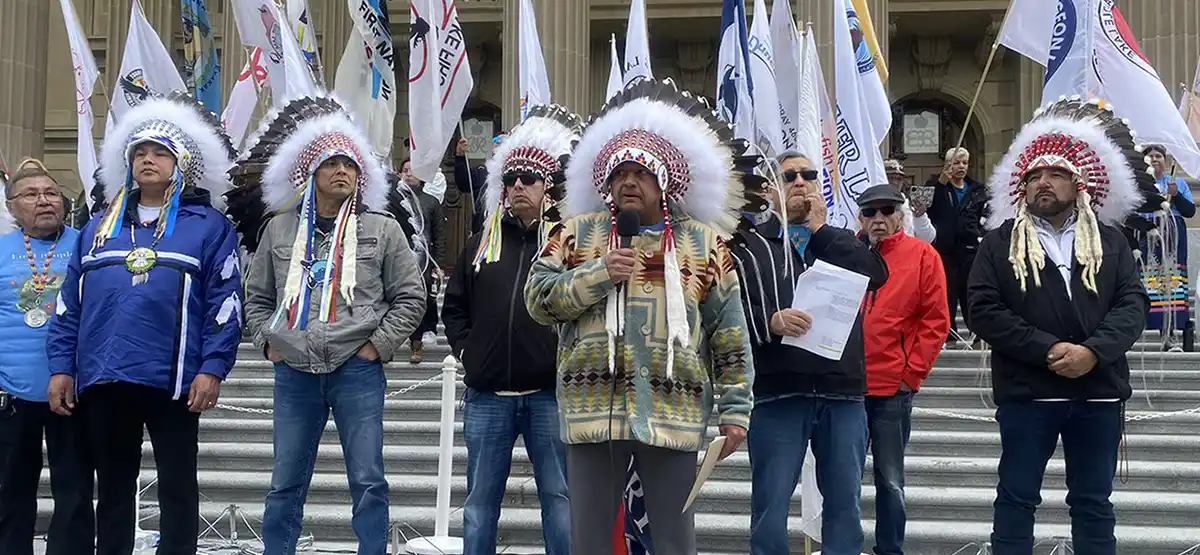
A group of Indigenous leaders, wearing traditional headdresses and regalia, stand together on steps with flags behind them. One leader speaks into a microphone while others stand in solidarity.

Treaty chiefs protest separatism at legislature rally

Hundreds of people attended a rally that First Nations leaders from across Alberta organized at the legislature in Edmonton to protest ongoing separatist threats, which every speaker agreed would run roughshod over treaty rights.

The May 15 event opened with drumming and a grand entry while elders burned sacred herbs for smudging, followed by remarks from leaders representing treaties 6, 7 and 8.

The protest was a way for treaty First Nations in Alberta to present a united front in the face of Bill 54, which lowers the threshold for bringing forward a referendum. 

Premier Danielle Smith has said that she will hold a referendum on independence in 2026 if a petition in support of one gets enough signatures.

“Let us stand loud and clear and concise that no provincial government can hold a referendum to overturn our treaty,” Confederacy of Treaty 6 First Nations Grand Chief Greg Desjarlais told attendees. “We do not answer to the provincial government.”

Desjarlais, who is also the elected chief of Frog Lake First Nation, said he “took many arrows and many bullets, many from my own people” for meeting with Premier Smith about Bill 54, which he said was part of the confederacy’s “diplomatic” and “patient” approach to the separatist threat.

The meeting resulted in Justice Minister Mickey Amery amending the bill to say that no separation referendum question can threaten First Nations treaty rights, which First Nations leaders dismissed as meaningless.

“Let me be clear, this push for Alberta separation is not just dangerous, it’s a violation of treaty, natural law and the land itself,” said Desjarlais. 

Treaties 6, 7 and 8 were signed in 1876, 1877 and 1899, respectively, all before Alberta was established as a province in 1905. 

Treaty 8 Grand Chief Trevor Mercredi commented that the day’s display of unity “is what we’ve needed for a long time.”

“When our nations and our treaty are threatened, we need to come together,” he added. 

“There’s no separation between the chiefs and the councils and our people. We are all treaty people when it comes to our treaty. Each and every meeting that we are attending is to protect our children.”

Grand Chief Mercredi emphasized that this includes non-Indigenous people as well.

“If you’re in Alberta, in Canada, you are recognized as [part of the] treaty,” he said. 

Representing Treaty 7 was Tsuut’ina Minor Chief Regena Crowchild, who spoke on behalf of Chief Roy Whitney. 

“Any attempt to undermine or infringe on our treaty rights will be met with unwavering resistance,” said Crowchild, who emphasized that she hasn’t had any discussion “whatsoever” with the premier on Bill 54. 

“Defending our treaty rights has always been a priority for me, and there are numerous examples of Tsuut’ina taking a strong stand against both federal and provincial actions that threaten those rights.”

Saddle Lake Cree Nation Chief Jason Whiskeyjack said it’s important to take the message “that we are stronger together” to the legislature. 

“We have to celebrate who we are as a people, and when we do that the people are going to hear, not only here in this building but every Albertan in this Treaty 6, 7 and 8 territory. They need to be reminded that this is treaty land. Everywhere they go is treaty land,” he said. 

“There’s a lot of people wanting to separate. That’s fine. They could just leave.”

Chief Wilfred Hooka-Nooza of Dene Tha’ First Nation in Treaty 8 said attendees were gathered “not as protesters, but as guardians of a promise older than the province of Alberta itself.”

“Our treaties are not relics. They are not documents to be shelved and forgotten,” Chief Hooka-Nooza added. “They are living, breathing commitments. They are a promise of coexistence, mutual respect and shared responsibility to this land we call home.”

In addition to band leaders, Indigenous NDP MLAs Brooks Arcand-Paul of Alexander First Nation and Jodi Calahoo Stonehouse of Michel First Nation were at the event, as was independent MLA Scott Sinclair, who is non-status First Nation.

Also in attendance were Alberta NDP Leader Naheed Nenshi and several other NDP MLAs, Edmonton Mayor Amarjeet Sohi, and former deputy premier Thomas Lukaszuk, as well as Alberta Federation of Labour president Gil McGowan and secretary-treasurer Cori Longo.


Alberta | AB, Alberta First Nations, alberta news, Alberta Separation | Independence | Bill 54, Alexander First Nation – Alberta, Dene Tha' First Nation – Alberta, Frog Lake First Nation – Alberta, Indigenous Perspectives, Indigenous Treaty Rights, Michel First Nation – Alberta, Piikani Nation | Brocket – Alberta, Saddle Lake Cree Nation – Alberta, Treaty 6 – Alberta, Treaty 7 – Alberta, Treaty 8 – Alberta

A group of Indigenous men, wearing traditional feathered headdresses and regalia, stand together indoors. One man speaks at the front, while others stand behind him against a gray background.

First Nations must be part of Alberta separation debate, says Piikani chief

Piikani Nation Chief Troy Knowlton is voicing firm opposition to recent moves by the Alberta government that critics say are advancing a separatist agenda, warning that any steps toward separation must respect treaty rights and cannot proceed without First Nations’ consent.

In a statement issued May 1, Knowlton emphasized that treaties 6, 7 and 8 predate the formation of Alberta and remain legally binding.

“Those are treaties with the Crown, and Alberta lacks the authority to interfere with or negate those treaties,” he said.

“Proceeding down a path towards separation cannot be undertaken without the consent of Alberta’s First Nations.”

Knowlton added that Indigenous communities will “aggressively protect” their treaty and inherent rights.

“We will require that the Crown’s obligations to First Nations be honoured and fulfilled,” he said.

The chief’s comments come amid growing political tension in Alberta after the recent federal election, in which the Liberal party retained power without significant support from western provinces.

“There is no question that the results of the recent federal election have exacerbated pre-existing regional tensions in Canada,” he said. “It is understandable that many people in the West are frustrated that their rejection of the Liberal party was not mirrored in other parts of Canada.”

That frustration, according to Knowlton, has fuelled renewed momentum among some organizers advocating for Alberta’s separation. They claim to be gathering signatures in support of a referendum on the province’s future within Confederation.

Premier Danielle Smith’s government has proposed Bill 54, legislation that would lower the number of signatures required to trigger a referendum on constitutional matters.

Knowlton pointed to this bill — along with talk of a “what’s next” panel — as signs of a broader push toward constitutional renegotiation or potential separation.

On April 30, Alberta NDP Leader Naheed Nenshi also weighed in, accusing Smith of actively fostering a separatist agenda doing everything in her power to make a referendum on separatism happen.

“Alberta is at a crossroads and Danielle Smith is leading us down a dangerous path,” Nenshi said.

He cited Smith’s endorsement of the Free Alberta Strategy, the passage of the Sovereignty Act, efforts to replace the RCMP with a provincial police force, and a proposal to withdraw from the Canada Pension Plan as examples of separatist-leaning policy.

“The president of the UCP has stated on social media that Albertans are going to get a referendum,” Nenshi said, adding that changes to provincial election laws by the Smith government make it easier to hold a referendum on constitutional issues.

He called on the premier to stop “pretending and flirting with separatism” and hold a referendum.

“And when she loses that referendum, she needs to leave public life forever,” he said.

The Alberta NDP has launched an online petition at SeparatistSmith.ca, encouraging Albertans to affirm their commitment to remaining within Canada.

“Let’s send a message to Danielle Smith,” Nenshi said. “Let her know we believe in Alberta, we believe in Canada, and we’re not going anywhere.”

Tensions around Alberta’s place in Confederation have grown in recent years, particularly under Smith’s leadership.

In 2022, her government passed the Alberta Sovereignty Within a United Canada Act, asserting the province’s right to refuse enforcement of federal laws it deems harmful and in violation of the federal-provincial division of powers.

More recently, the UCP government introduced Bill 54 to make it easier to trigger referendums, and has supported initiatives like withdrawing from the Canada Pension Plan and creating a provincial police force.

These moves, while framed by the government as efforts to assert provincial autonomy, have led critics to accuse Smith of pursuing a separatist agenda.

Smith says Alberta separation referendum must be citizen-led

Alberta | AB, Alberta First Nations, alberta news

If the trout are gone, is it still Trout Creek?

On a summer’s day an unknown photographer focused his Kodak Brownie on four adults and a child, out for a day’s fishing on Trout Creek. The photograph, now in the Glenbow archives, is labelled “Fishermen with catch, Trout Creek, Alberta. July, 1902.”

And what a catch it was — a pile of native cutthroat trout, well over a hundred, and maybe 75 kilograms in total.

Native cutthroat trout lingered, though declining, over the next century or so in this tiny stream that flows off the east side of the Porcupine Hills in southwestern Alberta. They were still present in 2013 when Elliot Lindsay, a biologist with Trout Unlimited, caught his first cutthroat trout there. When Government of Alberta biologists sampled the stream in 2015 they recorded hundreds of trout.

By 2019, those hundreds had dwindled and Trout Unlimited caught only two from a subset of the same stream reaches. Unfortunately, contagion with genetic material from non-native rainbow trout was already well established.

Further investigations in 2021 by the Blackfoot Confederacy Tribal Council Native Trout Recovery Project, using environmental DNA, failed to find any strong evidence of pure-strain cutthroat trout in the watershed.

The population may not be functionally extirpated, but is teetering. If it falls off the edge, this is extirpation in real time, not ancient history, but virtually overnight, with a timeline of just yesterday. It might be like Hemingway’s description of bankruptcy: gradual, then sudden.

The loss of a native population of cutthroat trout calls for a post-mortem. How could this have happened, after the species was designated as threatened, a recovery strategy was implemented, and much fanfare was made of restoration efforts? Call it death by a thousand cuts, starting with the cruellest cut, timber harvest.

The Trout Creek watershed has been extensively logged, with large clear-cuts, a web of logging roads and inadequate streamside buffers. Roads begat more recreational traffic, with spirals of off-highway vehicle trails, adding to the linear density and sediment produced. Past cattle grazing may have reduced streamside willows, increasing bank instability.

Climate change brought persistent drought periods. Coupled with hydrologic shifts from logging, and the loss of beaver, the watershed has lost much of its ability to store moisture and stream sections periodically dry up. Recent protracted drought conditions, added to creeping hybridization, may be the last straw.

In the past, natural conditions may well have produced similar drought conditions and low or no surface flows. However, there would have been connections with other cutthroat populations in the wider watershed, allowing movement and replenishment under better flows. The problem is now there is no rescue option from downstream sources; cutthroat trout no longer exist in the lower watershed.

In the departmental and bureaucratic silos of land and resource management resides little chance for rescue, since few see (and are responsible) for the bigger picture — the additive, cumulative impacts. When no one is assigned to watch, no one seems responsible when the essential pieces of landscape and watershed integrity come unglued.

As Vic Adamowicz, a professor at the University of Alberta, observed, “Under Alberta’s public land management system, the cost of habitat loss is only considered after economics are accounted for, and there is no reason for resource sectors to co-ordinate activities, resulting in destructive cumulative effects.”

We inherit the world we allowed to happen; we find out, sometimes too late, the kind of world we create when things are allowed to proceed unhindered. And so, the native cutthroat population of Trout Creek, having persisted for at least a dozen millennia, comes to a whimpering end.

So ends a population intimately tied to the watershed, having been tested and evolved to deal with the considerable range of natural variation expressed over time beyond human imagination. This we do not mourn, either because we do not care to know, or we do not know to care.

Fortunately there are a few that do care. Organizations like Trout Unlimited and Cows and Fish plug away, increasing awareness about native trout and their plight. Bit by bit, metre and metre, mind by mind, they rebuild battered stream banks, close off excessive OHV trails, work with ranchers on riparian grazing management solutions, and help people see the trout for the trees.

Provincial fisheries biologists work on the development of a composite brood stock of pure-strain cutthroat trout. Once habitat conditions are stabilized and improved, this offers an opportunity to restock the stream and restore the cutthroat population.

To spell cutthroat trout you need only arrange 14 letters in the right order. But to make a trout you need a huge array of biotic and abiotic material and assemble it in precisely the right sequence.

Beyond water, both quantity and quality, intact forest and watershed, aquatic insects, a combination of stream characteristics, the right genetic code, population critical mass, movement ability, grappling with limiting factors, and the time to evolve to fit the stream environment, even knowing what the essential parts are and how they fit together may not be evident.

It is decidedly not like baking a cake. That is the challenge to restore native cutthroat trout to Trout Creek, now that they have largely gone missing.

In spite of the challenges, you can’t help but be impressed with the infectious optimism of people like Elliot Lindsay with Trout Unlimited, Amy McLeod with Cows and Fish, and many provincial fisheries biologists who will not give up on Trout Creek. They will need to think big, since real recovery can only happen at a watershed scale. It might require the equivalent of a moon shot to bring native cutthroat back to the stream.

While much work remains to deal with the proliferation of OHV trails and crossings, as well as riparian grazing management fixes, the fundamental task might be to restore the capability of the watershed to retain and store water.

This watershed once had dozens and dozens of beaver dams, effectively drought-proofing the system. When R.B. Miller, Alberta’s first fisheries biologist, initially surveyed the watershed in 1948, he commented on the number of beaver dams.

The Burke Creek Ranch has been situated in the Trout Creek watershed since 1890. Rick Burton, the third generation on the ranch, recalls the headwaters and tributaries being wetter and having more beaver dams in the 1960s and ’70s. Beaver activity is now spotty. But beavers still remain and that is a hopeful sign.

Restoration plans include the installation of multiple beaver dam analogues — structures designed to mimic the form and function of a natural beaver dam — in different reaches of the watershed. These structures are meant to jump-start the growth of woody shrubs and entice beavers to move in and take over.

As Elliot says, “Ultimately, the beaver are probably the ones who will be able to have the might and persistence to kick this watershed out of the rut that it’s currently in.”

Fingers crossed, I hope habitat restoration, coupled with the availability of pure-strain cutthroat trout for stocking, can someday bring trout back to Trout Creek. With a name like Trout Creek, it seems like the right thing to do.

At the same time, some receptivity needs to be built in the minds of those who contributed to the disappearance of cutthroat trout. If there is no shame in being party to the loss of an ancient element of a watershed, it will happen again, and again.

In an indeterminate future, if all the aquatic stars align, someone may take a picture of a group of anglers on Trout Creek, not with a large stringer of native trout, but with smiles indicating their satisfaction with a day of fishing on a stream brought back to life.

Lorne Fitch, P. Biol.


Shootin’ the Breeze welcomes submissions about local issues and activities. Personal views expressed in Mailbox articles are those of the writers and do not necessarily reflect views of Shootin’ the Breeze management and staff. 


More from the Breeze:

Public hearing focuses on proposed gravel pit

Critical water lines to be repaired in Pincher Creek

Proposed water allocation changes cause local turbulence


Alberta | AB, Amy McLeod, Burke Creek Ranch, Cows and Fish, cutthroat trout, Elliot Lindsay, Environment, Porcupine Hills, Rick Burton, trout, Trout Creek, Trout Unlimited, Vic Adamowicz, watershed restoration