

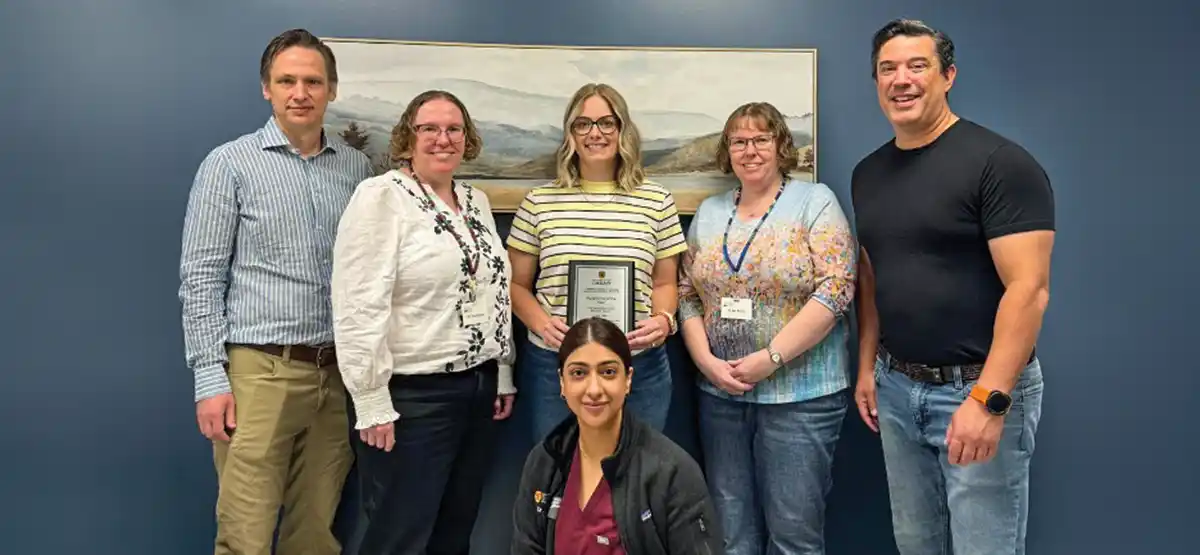
Associate Clinic wins U of C rural teaching award
Hunting trips, coaching, weekly pickup soccer — when medical residents train at Pincher Creek’s Associate Clinic, they learn more than medicine. A community-immersed approach has earned the clinic the University of Calgary’s Rural Family Medicine Clinic of the Year award for 2025-26.
The award, presented annually through the university’s Rural Family Medicine Residency Program, recognizes a clinic that provides a welcoming and supportive learning environment while modelling high-quality, comprehensive patient care.
The Associate Clinic was nominated by multiple student residents and selected from a field of several finalists by the program’s resident body.
Dr. Gavin Parker, a physician at the clinic and clinical associate professor with the U of C’s Cumming School of Medicine, says the recognition was meaningful for the entire team.
“We work very closely with a lot of the other rural sites, so we’re pretty knowledgeable about the excellent clinical work that happens across the province,” he says. “We’re certainly honoured by it.”
The award reflects a long-standing commitment to teaching and mentorship. Parker estimates the Associate Clinic has been training medical learners for more than 40 years and all seven of its physicians serve in teaching roles.
Residents and medical students rotate through a range of health-care settings including family medicine, emergency medicine, surgery, inpatient care and community-based health care. Learners also work alongside allied health professionals such as respiratory therapists, dietitians and mental health practitioners, and take part in weekly simulation training.
“We really do prioritize the learner experience in our community,” Parker says. “We’ve got a really fantastic group of physician preceptors and, equally important, we’ve got a really great staff that creates a welcoming environment for these students.”
The clinic typically hosts three to four residents at a time, with 15 to 20 completing rotations in Pincher Creek each year.
Beyond clinical training, the team encourages learners to step into local activities, from coaching youth sports to attending events and finding volunteer opportunities.
According to Parker, understanding the broader role physicians play in a rural community is an important part of medical education. That sense of connection benefits both learners and the community.
“We’ve had several of our learners coach volleyball or basketball, or get involved with Lego League or whatnot in town, and so kind of really showing them the role that physicians play in a community outside of the medical context,” he says.
That connection positively supports physician recruitment, a challenge faced by many rural communities.
“Most of the data shows that the earlier and longer that you can expose medical learners to the rural context, the more likely they are to make that as part of their career path,” Parker says.
This approach has already paid dividends locally. Several former learners have returned to work at the Associate Clinic, including current physician Dr. Ashley Rommens, who completed her residency there before joining the team.
Parker also recalls a former resident who was invited on a hunting trip by a Pincher Creek resident during their rotation and has since returned as a locum physician.
“The communities that do really well — and this is not just physicians, but nurses, allied health professionals, teachers as well — if you want to recruit those professionals, you have to make it a welcoming community,” Parker says. “It’s cliché, but it literally does take a village.”
Parker says the recognition belongs to far more than just the physicians.
“It’s massively a team effort,” he says. “It’s everybody. It’s all the way down to our reception, our schedulers, finance people, all our allied health professionals and all the other preceptors, the learners themselves and the community at large.”
He considers Pincher Creek’s supportive environment a major reason the clinic has been able to build a successful teaching program.
“It’s an awesome place to work,” he says, “and I think if it wasn’t because of the community making it such a great place to work, it’d be hard to win awards like this.”


Southwest Alberta News, Features and Events
-
 Shootin’ the Breeze Newspaper — Oct. 7, 2026
-
 Fort Macleod ER closed tonight, Pincher Creek among backups
-
 Aspen Wilson located safe, Valleyview RCMP cancel Amber Alert
-
 Travelling Library a hit with Piikani children and elders
-
 Checks, balances and one Canada
-
 Randy Plain Eagle brings his story and his stage home
-
 Thirty years on, Irene Hollander still walks for Terry Fox
-
 Daughter shares Rose Potts’s residential school story at Vista Village
-
 Allison Creek camp asks for pause on West Fraser harvest
-
 Residents seeking time with town council face new rules
-
 Shootin’ the Breeze Newspaper — Sept. 30, 2026
-
 A Piikani mother puts one foot in front of the other for her daughter


Southwest Alberta Municipal News


Government of Alberta News

Alberta RCMP

Obituaries
Opinions

Associate Clinic wins U of C rural teaching award
Hunting trips, coaching, weekly pickup soccer — when medical residents train at Pincher Creek’s Associate Clinic, they learn more than medicine. A community-immersed approach has earned the clinic the University of Calgary’s Rural Family Medicine Clinic of the Year award for 2025-26.
The award, presented annually through the university’s Rural Family Medicine Residency Program, recognizes a clinic that provides a welcoming and supportive learning environment while modelling high-quality, comprehensive patient care.
The Associate Clinic was nominated by multiple student residents and selected from a field of several finalists by the program’s resident body.
Dr. Gavin Parker, a physician at the clinic and clinical associate professor with the U of C’s Cumming School of Medicine, says the recognition was meaningful for the entire team.
“We work very closely with a lot of the other rural sites, so we’re pretty knowledgeable about the excellent clinical work that happens across the province,” he says. “We’re certainly honoured by it.”
The award reflects a long-standing commitment to teaching and mentorship. Parker estimates the Associate Clinic has been training medical learners for more than 40 years and all seven of its physicians serve in teaching roles.
Residents and medical students rotate through a range of health-care settings including family medicine, emergency medicine, surgery, inpatient care and community-based health care. Learners also work alongside allied health professionals such as respiratory therapists, dietitians and mental health practitioners, and take part in weekly simulation training.
“We really do prioritize the learner experience in our community,” Parker says. “We’ve got a really fantastic group of physician preceptors and, equally important, we’ve got a really great staff that creates a welcoming environment for these students.”
The clinic typically hosts three to four residents at a time, with 15 to 20 completing rotations in Pincher Creek each year.
Beyond clinical training, the team encourages learners to step into local activities, from coaching youth sports to attending events and finding volunteer opportunities.
According to Parker, understanding the broader role physicians play in a rural community is an important part of medical education. That sense of connection benefits both learners and the community.
“We’ve had several of our learners coach volleyball or basketball, or get involved with Lego League or whatnot in town, and so kind of really showing them the role that physicians play in a community outside of the medical context,” he says.
That connection positively supports physician recruitment, a challenge faced by many rural communities.
“Most of the data shows that the earlier and longer that you can expose medical learners to the rural context, the more likely they are to make that as part of their career path,” Parker says.
This approach has already paid dividends locally. Several former learners have returned to work at the Associate Clinic, including current physician Dr. Ashley Rommens, who completed her residency there before joining the team.
Parker also recalls a former resident who was invited on a hunting trip by a Pincher Creek resident during their rotation and has since returned as a locum physician.
“The communities that do really well — and this is not just physicians, but nurses, allied health professionals, teachers as well — if you want to recruit those professionals, you have to make it a welcoming community,” Parker says. “It’s cliché, but it literally does take a village.”
Parker says the recognition belongs to far more than just the physicians.
“It’s massively a team effort,” he says. “It’s everybody. It’s all the way down to our reception, our schedulers, finance people, all our allied health professionals and all the other preceptors, the learners themselves and the community at large.”
He considers Pincher Creek’s supportive environment a major reason the clinic has been able to build a successful teaching program.
“It’s an awesome place to work,” he says, “and I think if it wasn’t because of the community making it such a great place to work, it’d be hard to win awards like this.”

You must be logged in to post a comment.
Southwest Alberta News, Features and Events
- Shootin’ the Breeze Newspaper — Oct. 7, 2026
- Fort Macleod ER closed tonight, Pincher Creek among backups
- Aspen Wilson located safe, Valleyview RCMP cancel Amber Alert
- Travelling Library a hit with Piikani children and elders
- Checks, balances and one Canada
- Randy Plain Eagle brings his story and his stage home
- Thirty years on, Irene Hollander still walks for Terry Fox
- Daughter shares Rose Potts’s residential school story at Vista Village
- Allison Creek camp asks for pause on West Fraser harvest
- Residents seeking time with town council face new rules
- Shootin’ the Breeze Newspaper — Sept. 30, 2026
- A Piikani mother puts one foot in front of the other for her daughter
Alberta and Beyond News, Features and Events
-
 Community celebrates completion of Allison Falls Trail
-
 Adaptable Outdoors wraps season with 300 experiences delivered
-
 Pincher Creek area under fire restriction
-
 Park Guardian Program supports clean green spaces
-
 Bear advisory issued for Alberta’s backcountry and outdoor areas
-
 Volunteers drive Star Creek Trail upgrades for improved hiking experience in Crowsnest Pass
-
 Heed the heat — tips to keep dogs cool and hydrated
-
 Crowsnest to see hiking trail improvements this summer
-
 Safe adventuring
-
 Summer paddling opportunities
-
 Take river safety seriously
-
 Alberta Conservation reminds us to be bear smart


Southwest Alberta Municipal News
Government of Alberta News
Alberta RCMP
Obituaries
You must be logged in to post a comment.